

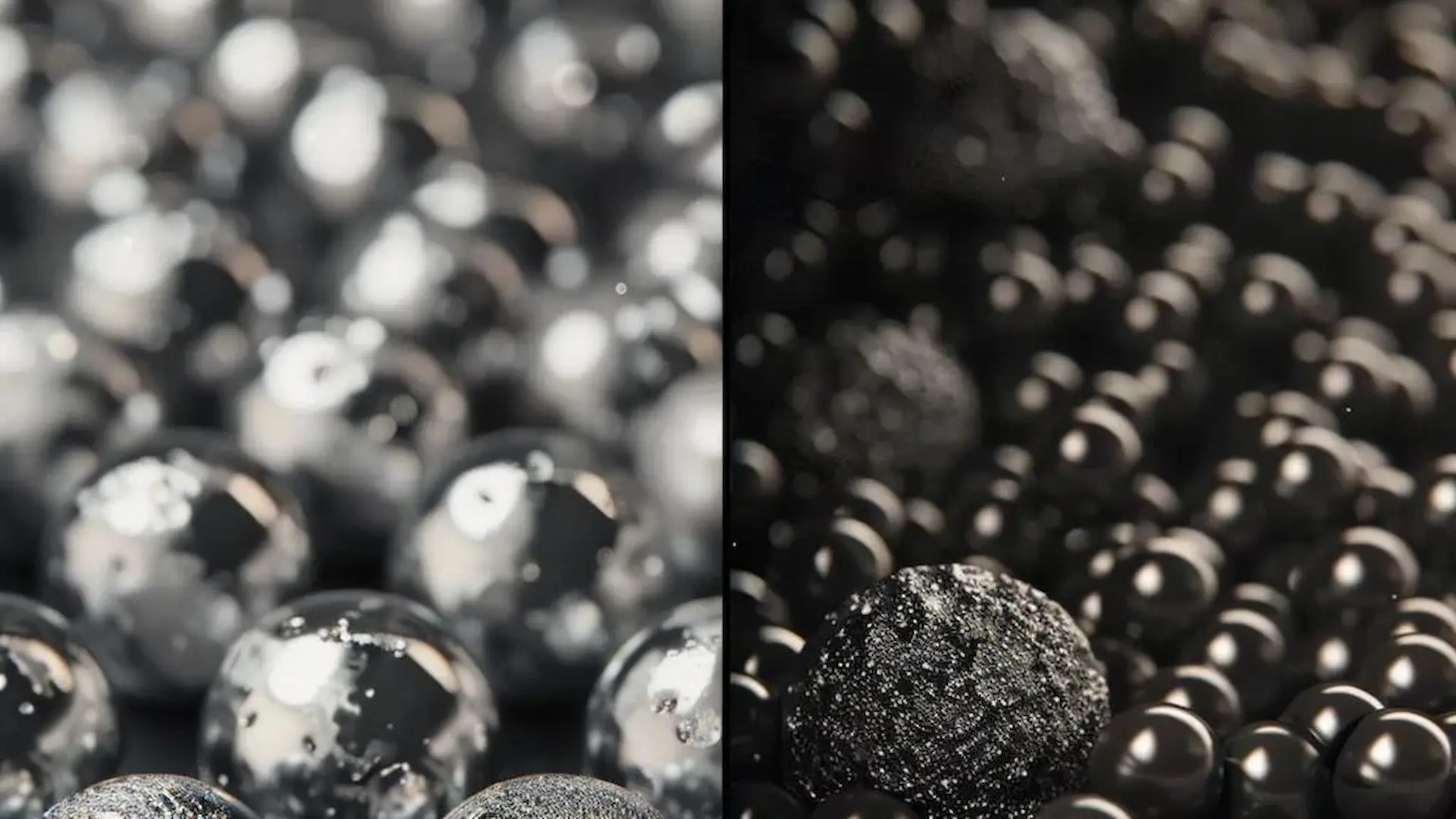
Every grinding media decision comes down to material properties. Density sets impact energy. Hardness sets wear rate. Chemistry sets contamination risk. This guide compares the materials engineers actually specify, steel, stainless, alumina, zirconia, silicon nitride, glass, and tungsten carbide, with verified property data so you can match the material to the process.
For the step-by-step selection process, start with our grinding media selection guide.
Master Comparison Table
| Material | Density (g/cm3) | Hardness | Wear resistance | Contamination risk | Relative cost |
|---|---|---|---|---|---|
| Chrome steel (52100) | 7.8 | 60 to 67 HRC | High | Iron/chromium debris | $ |
| Forged carbon/alloy steel | 7.8 | 58 to 65 HRC | High | Iron debris | $ |
| Stainless steel (440C) | 7.75 | 58 to 63 HRC | High | Low metallic | $$ |
| Alumina 92% | 3.6 | Mohs 9 | High | Minimal | $$ |
| Alumina 99% | 3.9 | Mohs 9 | Very high | Minimal | $$ |
| Zirconia (YSZ) | 6.0 to 6.1 | Mohs 8.5 | Exceptional | Negligible | $$$ |
| Silicon nitride | 3.2 | ~1550 HV | Exceptional | Negligible | $$$$ |
| Soda-lime glass | 2.5 | Mohs ~6 | Moderate | None (silica) | $ |
| Tungsten carbide | 14.3 to 15.0 | Mohs 9 to 9.5 | Extreme | Low | $$$$ |
Density and hardness figures are typical values from manufacturer specifications and materials references. Exact values vary by grade, binder content, and sintering process.
Steel Grinding Media: Chrome, Forged, and Stainless

Chrome steel (AISI 52100)
Through-hardened chrome steel is the benchmark grinding ball material. At 60 to 67 HRC and 7.8 g/cm3, it delivers the highest impact energy per collision of any economical media, with through-hardness that resists both abrasive wear and deformation under heavy mill loads. It is magnetic, which simplifies separation in some circuits, but it will rust in wet service and sheds iron and chromium wear debris into the product.
Best for: mining ball mills and SAG mills, cement grinding, any coarse high-throughput duty where contamination is not restricted.
Forged carbon and alloy steel
Forged balls trade a few points of surface hardness for impact toughness and lower cost. They survive the violent charge motion of large mills without spalling, which is why they dominate primary grinding in mineral processing. Typical hardness runs 58 to 65 HRC depending on alloy and heat treatment.
Best for: large-diameter mill charges, autogenous and semi-autogenous grinding, cost-driven high-tonnage operations.
Stainless steel (440C and austenitic grades)
Martensitic 440C reaches 58 to 63 HRC at 7.75 g/cm3 with good corrosion resistance in water, steam, and mild chemicals. Austenitic grades (304, 316) are softer but essentially non-magnetic and highly corrosion resistant. Stainless media suit wet milling of food, pharmaceutical intermediates, and chemicals where rust contamination from carbon steel is unacceptable but ceramic cost cannot be justified.
See our steel ball manufacturing capabilities for grades, sizes, and tolerances.
Ceramic Grinding Media: Alumina, Zirconia, Silicon Nitride
Alumina (Al2O3)
Alumina is the economical ceramic. Grades run from 92% Al2O3 (about 3.6 g/cm3) to 99% (about 3.9 g/cm3), all near Mohs 9 hardness. Higher purity means lower wear and less contamination: 99% alumina measurably outlasts 92% in abrasive service. Alumina resists acids and alkalis across a wide pH range and stays stable well above 1000 C. Rolled balls suit wet grinding; isostatically pressed balls give higher density and impact resistance for dry milling.
Best for: ceramic raw materials, minerals, paints and coatings, general-purpose milling where contamination must stay low at moderate cost.
Zirconia (yttria-stabilized, YTZ)
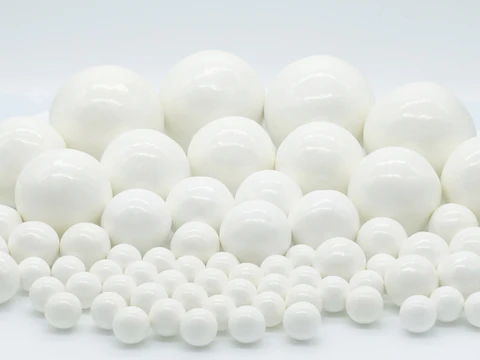
Yttria-stabilized tetragonal zirconia polycrystal is the premium grinding ceramic. At 6.0 to 6.1 g/cm3 it carries nearly twice the impact energy of alumina at the same mill speed, while its fracture toughness, far above alumina, resists chipping in high-energy stirred and planetary mills. Wear debris is negligible and chemically inert, which is why zirconia is the default media for pharmaceutical APIs, food, battery materials, electronic ceramics, and any process where a trace of contamination scraps the batch.
Best for: ultra-fine and nano grinding, contamination-critical milling, high-energy stirred media mills.
Silicon nitride (Si3N4)
At about 3.2 g/cm3 with Vickers hardness around 1550 HV, silicon nitride combines light weight with extreme hardness and fracture toughness. It is chemically inert to acids and alkalis and stable to high temperature. Its main grinding-media role is in demanding specialty milling, advanced ceramics, and magnetic materials, where its wear resistance exceeds even zirconia. Finished silicon nitride balls are covered by ISO 3290-2 and related bearing-ball standards.
Best for: specialty high-purity milling, advanced ceramics, applications needing maximum wear resistance at low density.
Glass, Silicon Carbide, and Other Media
Glass beads
Soda-lime glass beads at 2.5 g/cm3 are the softest mainstream media at about Mohs 6. That softness is the point: in pigment, dye, and ink mills they disperse without overgrinding or introducing metal ions, protecting color strength and product safety. Borosilicate beads add chemical and thermal resistance for harsher slurry chemistry.
Best for: paints, pigments, dyes, inks, agricultural chemicals, any dispersion process where gentle action and zero metallic contamination matter.
Tungsten carbide
Cemented tungsten carbide, typically WC with a cobalt binder, reaches 14.3 to 15.0 g/cm3 at Mohs 9 to 9.5, roughly twice the density of steel. That density makes it the highest-energy media available, suited to ultra-fine milling of the hardest, most abrasive feeds. The trade-off is cost and brittleness relative to steel: it excels in small sizes and controlled mill conditions, not in large primary-mill charges.
Best for: laboratory and production mills grinding very hard or abrasive materials to ultra-fine sizes.
Silicon carbide and natural media
Silicon carbide (about 3.2 g/cm3, Mohs 9+) serves abrasive specialty grinding. Natural agate and flint pebbles, once common, survive only in laboratory work where absolute contamination freedom justifies their low throughput.
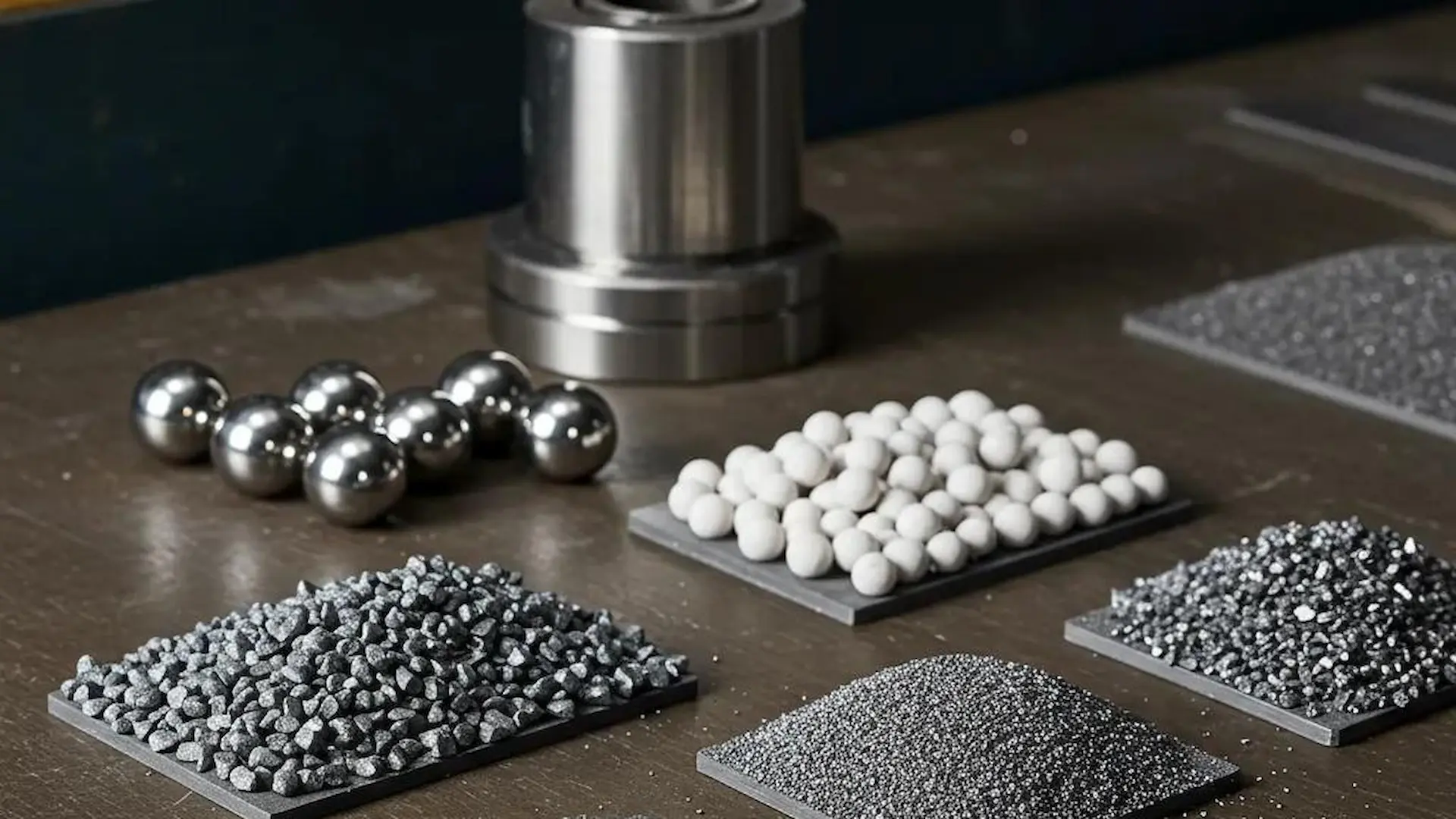
How Material Properties Drive Milling Performance
Density and energy transfer
Kinetic energy rises with media mass, so at equal size and speed, steel hits about three times harder than glass and tungsten carbide hits about twice as hard as steel. Higher density shortens grinding time for a given fineness target but raises power draw and liner wear. In stirred mills, where tip speed is high and media are small, the density advantage of zirconia over alumina translates directly into throughput.
Hardness and wear rate
Media must be harder than the feed to grind efficiently rather than be ground. Chrome steel at 60 to 67 HRC handles most mineral feeds; alumina at Mohs 9 and tungsten carbide at Mohs 9 to 9.5 handle harder abrasives. But hardness without toughness causes fracture: in high-impact mills, forged steel and stabilized zirconia outlast harder but more brittle options because they absorb impact without spalling.
Chemical inertness and purity
Every media sheds some wear debris. The question is whether the product tolerates it. Steel debris is acceptable in iron ore grinding and fatal in white pigment or lithium battery cathode production. Ceramics and glass shed orders of magnitude less material, and what they shed is chemically inert. In regulated industries, media choice is effectively dictated by the contamination specification.
Size, shape, and grade
Smaller media give finer product but increase charge surface area and heat; larger media give higher impact per collision. Spherical balls give predictable motion and minimal breakage; cylpebs add surface contact for fine grinding. Precision grades under ISO 3290 and DIN 5401 control diameter variation, sphericity, and surface finish, and tighter grades produce more consistent mill behavior. Our ceramic ball and steel ball pages detail available sizes and grades.
Ceramic vs. Steel: Head-to-Head
| Factor | Steel | Ceramic |
|---|---|---|
| Impact energy | Higher (density 7.8) | Lower to comparable (3.6 to 6.1) |
| Hardness | 60 to 67 HRC | Mohs 8.5 to 9 |
| Contamination | Metallic wear debris | Negligible |
| Corrosion | Rusts (except stainless) | Inert |
| Toughness | Excellent | Good; zirconia best |
| Purchase price | Lower | Higher |
| Typical service | Mining, cement, coarse grinding | Pharma, food, pigments, fine grinding |
The practical rule: specify steel where the process allows it, and ceramic where the product requires it. Many plants run both, steel in primary grinding and ceramic in finishing, to get the economics of each where they count. Browse the full grinding media range to see available materials and sizes side by side.
Media Microstructure and Quality Factors
Beyond chemistry, how media are made affects how they perform:
- Uniform microstructure: evenly distributed grain structure resists chipping and spalling. In steel, through-hardening gives consistent hardness from surface to core; in ceramics, controlled sintering gives uniform density.
- Sphericity: out-of-round media collide unevenly, wear faster, and produce inconsistent product. Precision grades under ISO 3290 and DIN 5401 limit deviation from spherical form.
- Surface finish: rough or pitted surfaces wear faster and can trap product. Polished media run cleaner and last longer, which matters in finishing mills and burnishing.
- Internal defects: voids, inclusions, or cracks become fracture points under impact. Reputable manufacturers inspect for these, which is one reason media from an audited, certified supplier outperforms ungraded imports.
Wet vs. Dry Milling: How the Process Changes Media Choice
The same media behave differently in wet and dry service:
- Wet milling uses a liquid carrier that cushions impacts, cools the charge, and carries fines away from the grinding zone. Media wear slower, corrosion matters (favoring stainless or ceramic), and slurry chemistry must be compatible with the media. Most ultra-fine milling is wet.
- Dry milling runs hotter with harder impacts and no corrosion, but media fracture risk rises and dust handling matters. Isostatically pressed ceramics and tough forged steels handle dry service best.
Match the media to the mode: corrosion-resistant or inert media for wet corrosive slurries, impact-tough media for dry high-energy duty.
Standards and Grades
Finished steel balls are specified under ISO 3290-1 and DIN 5401, which define grades G3 through G200 by diameter variation, deviation from spherical form, and surface roughness. Ceramic balls fall under ISO 3290-2. How these grades are achieved is a manufacturing question: see our ball manufacturing overview for the processes behind the grades. Reference the grade on every purchase order: it is the simplest way to guarantee you receive the same media lot to lot, and it gives both sides an objective standard if a quality dispute ever arises. For background on the ceramic ball strength standard, see ISO 19843:2018 at iso.org, and for alumina-specific property detail, this guide to alumina grinding balls is a solid reference.
Frequently Asked Questions
These are the questions engineers and buyers ask most often when comparing grinding media materials. Short answers, grounded in the property data above, with links to deeper sections where it helps.
Which grinding media material lasts longest?
It depends on the service. In corrosive wet milling, zirconia and alumina typically outlast steel by a wide margin because they do not corrode. In dry high-impact coarse grinding, forged steel’s toughness often wins. There is no single longest-lived media across all conditions, which is why wear should be evaluated in your actual process.
Is zirconia always better than alumina?
Not always. Zirconia is denser, tougher, and wears slower, but it costs substantially more. For moderate-duty milling with loose contamination limits, alumina delivers adequate performance at a lower price. Specify zirconia where fineness targets, contamination limits, or wear conditions demand it.
Can stainless steel replace ceramic for contamination control?
Sometimes. Stainless eliminates rust and reduces metallic contamination versus carbon steel, at a lower price than ceramic. But it still sheds metal ions, so for pharmaceutical, food, or battery-grade purity requirements, ceramic remains the safe choice.
What does a ball grade like G25 mean?
Ball grades under ISO 3290 and DIN 5401 define allowable diameter variation, deviation from spherical form, and surface roughness. Lower numbers mean tighter tolerances: G3 is far more precise than G200. Grinding media typically use commercial grades rather than precision bearing grades, but specifying the grade guarantees consistency lot to lot.
Get the Right Material for Your Mill
Material selection is where grinding media performance is won or lost, and the wrong choice shows up as contamination, excess wear, or wasted energy. STR Industries manufactures steel and glass grinding media in-house, finishes tungsten carbide media in-house from purchased blanks to your order, and supplies ceramic media in compositions matched to the application, in sizes from 1/64 inch to 6 inches in virtually any increment, all under ISO 9001 and TS 16949 certified quality systems.
Request a quote with your feed material, mill type, and target fineness, and our engineers will recommend the material and grade that fits. For application-specific guidance, see our grinding media supplier page.