
Picking the right steel for industrial work means understanding how chrome steel and stainless steel behave in the field. Both alloys bring useful traits, but their performance, durability, and cost can vary a lot depending on the application.
This article compares the two steels across composition, corrosion resistance, durability, common uses, and upkeep. Read on to quickly identify which material better matches your project’s demands.
Key differences between chrome steel and stainless steel in industrial settings
Chrome steel and stainless steel are both common in industry, but their chemistries and mechanical traits set them apart. Chrome steel, an alloy with notable carbon and chromium content, is prized for hardness and wear resistance — a natural fit for high-stress components.
Stainless steel, by contrast, has higher chromium levels and often additional alloying elements that give it strong corrosion resistance. It performs best where exposure to moisture or chemicals is a concern. Selecting the right alloy requires aligning those material properties with the operating environment.
What are the chemical compositions of chrome steel and stainless steel?
Composition largely determines how each steel behaves. Chrome steel typically contains roughly 0.5%–1.5% carbon and about 10%–20% chromium, which together increase hardness and strength.
Stainless steel normally has at least 10.5% chromium and may include nickel, molybdenum, and other elements to boost corrosion resistance and toughness. These differences explain much of their contrasting performance.
How does chromium content differ between chrome steel and stainless steel?
Chromium percentage is a primary differentiator. Chrome steel’s chromium usually sits between 10% and 20%, which supports hardness and wear resistance.
Stainless steel requires a minimum of around 10.5% chromium to form the passive layer that resists rust. That chromium-driven passivation is the key reason stainless performs better in corrosive environments.
What role do carbon and other alloying elements play in steel grades?
Carbon and additional alloying elements shape strength, hardness, ductility, and corrosion resistance. Higher carbon in chrome steel raises hardness and wear resistance, making it suitable for bearings, cutting tools, and other high-wear parts.
Stainless grades usually keep carbon lower and add nickel, molybdenum, or other elements to improve corrosion performance and ductility. Knowing how these elements interact helps you pick the right grade for a specific load and environment.
Research shows microstructure and exact composition strongly influence wear resistance, especially where corrosion and abrasion act together.
Steel Wear Resistance: Microstructure & Composition
Analyses link microstructure and chemical makeup to wear performance under corrosive conditions.
Impact–abrasive–corrosion wear of Fe-based alloys: Influence of microstructure and chemical composition upon wear resistance, VG Efremenko, 2013
How do corrosion resistance and durability compare between chrome steel and stainless steel?
Corrosion resistance and durability are decisive factors. Stainless steel is widely acknowledged for superior resistance to rust and corrosion, so it’s preferred where moisture, chemicals, or elevated temperatures are present.
Chrome steel delivers strength and wear resistance but is more vulnerable to corrosion in humid or chemically aggressive conditions. Your operating environment will largely determine which property—hardness or corrosion resistance—is more important.
Experimental work has examined corrosion wear for carbon and stainless steels under different loads and saline conditions to quantify these differences.
Carbon Steel vs. Stainless Steel: Corrosion Wear
Corrosion wear behavior of carbon steel and stainless steel samples was evaluated in 3.5 wt.% NaCl solution with tests run at loads of 9.6, 32, 54 and 71N.
Wear and corrosion wear of medium carbon steel and 304 stainless steel, JA Szpunar, 2006
What factors influence the corrosion resistance of each steel type?
Corrosion resistance depends on alloy chemistry—primarily chromium and nickel content—as well as environmental factors like humidity, temperature, and exposure to aggressive chemicals.
Surface condition, protective coatings, and maintenance practices also affect longevity. Assessing these variables helps predict service life and choose appropriate protection or alloying strategies.
How does durability affect industrial and commercial applications?
Durability dictates where each steel is best applied. Chrome steel’s hardness makes it ideal for high-stress parts such as tooling, bearings, and shafts that face heavy wear.
Stainless steel’s corrosion resistance and toughness make it favorable in food processing, pharmaceuticals, and marine settings where hygiene and long-term integrity matter. The right choice balances mechanical demands with environmental exposure.
What are the common applications and industry uses of chrome steel and stainless steel?
Both steels appear across many sectors. Chrome steel is common in toolmaking, bearings, and automotive components where wear resistance and strength are priorities.
Stainless steel is extensively used in food and beverage equipment, medical devices, and structural applications because of its corrosion resistance and hygienic surface properties. Matching materials to use cases avoids premature failure and reduces lifecycle costs.
| Material Type | Application | Benefits |
|---|---|---|
| Chrome Steel | Tool manufacturing | High hardness and wear resistance |
| Stainless Steel | Food processing | Excellent corrosion resistance and hygiene |
| Chrome Steel | Automotive components | Durability under high stress |
| Stainless Steel | Medical devices | Biocompatibility and corrosion resistance |
In which sectors is chrome steel predominantly used?
Chrome steel is a go-to for sectors that demand strength and wear durability. Automotive, aerospace, and heavy manufacturing use chrome alloys for parts that endure high stress and abrasion.
Its hardness makes chrome steel well suited to tools and machine components that operate under continuous or heavy loads.
Where is stainless steel preferred and why?
Stainless steel is selected when corrosion resistance and cleanliness are priorities. Industries like food and beverage, healthcare, and marine engineering favor stainless for its ability to resist rust and maintain sanitary surfaces.
Because it preserves structural integrity in wet or corrosive environments, stainless often outperforms alternatives where contamination or corrosion risk is high.
How do maintenance requirements and longevity differ between chrome steel and stainless steel?
Maintenance needs differ notably. Chrome steel typically requires closer inspection and more frequent protective treatment where corrosion risk exists.
Stainless steel generally needs less maintenance and offers longer service life in corrosive environments, lowering downtime and replacement frequency. These factors should be considered in lifecycle planning.
What are the recommended maintenance practices for each steel type?
Proper care extends the life of either alloy. For chrome steel, routine cleaning, corrosion inhibitors, and protective coatings help prevent rust and wear-related failure.
Stainless steel benefits from regular cleaning to remove contaminants and occasional passivation or polishing to restore the surface. Following manufacturer guidance preserves both function and appearance.
How does longevity impact total cost of ownership?
Longevity directly affects lifetime costs. Chrome steel often has a lower purchase price but may incur higher maintenance and replacement expenses over time.
Stainless steel usually costs more up front but can deliver better value through reduced upkeep and longer service life. Compare initial expenditure against projected maintenance and replacement when budgeting.
What are the environmental and cost considerations when choosing between the two steels?
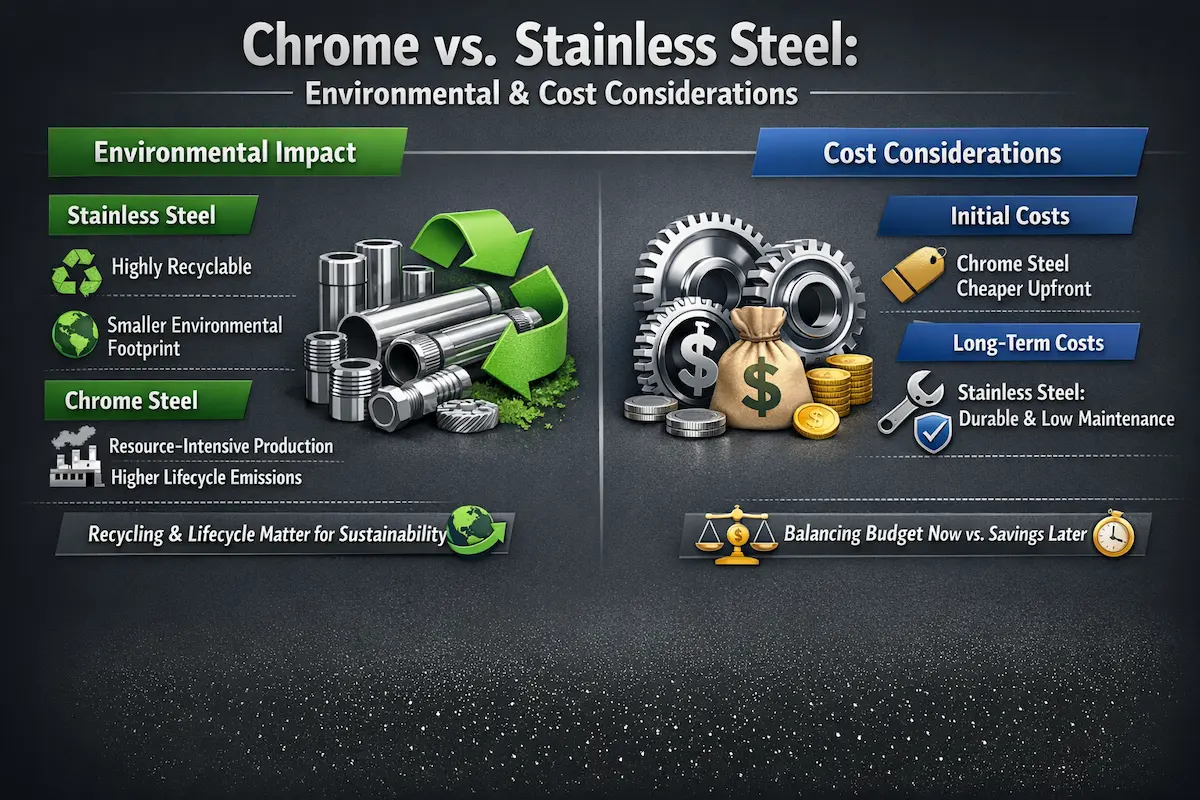
Environmental and cost factors both matter. Stainless steel is highly recyclable and can offer a smaller environmental footprint through reuse and recycling.
Chrome steel manufacturing can be resource-intensive; market prices and raw material demand also affect cost. Considering recyclability and lifecycle emissions is important for sustainability-focused projects.
How do production and recycling affect environmental impact?
Production and end-of-life processes shape each material’s environmental profile. Stainless steel’s high recyclability reduces waste and conserves resources.
Chrome steel production can be more energy- and resource-intensive, increasing its environmental impact. Choosing recycled content and responsible suppliers helps lower overall footprint.
What are the cost differences and economic implications?
Initial costs differ: chrome steel is generally less expensive, which can be attractive for budget-sensitive projects.
However, maintenance, downtime, and replacement costs influence total economic performance. In many cases, stainless steel’s durability and lower upkeep make it the more economical long-term choice.
Frequently Asked Questions
What is the main difference between chrome steel and stainless steel?
The core difference is alloying: chrome steel relies on higher carbon and chromium to boost hardness and wear resistance, while stainless steel emphasizes chromium (and often nickel or molybdenum) to provide superior corrosion resistance.
Which steel type is better for high-stress applications?
Chrome steel is typically better for high-stress, high-wear parts because of its greater hardness and wear resistance.
Is stainless steel more expensive than chrome steel?
Yes—stainless steel usually carries a higher upfront cost, but its longer service life and reduced maintenance can make it more cost-effective over time.
How do maintenance needs differ between the two steels?
Chrome steel generally needs more frequent maintenance to prevent corrosion, especially in humid or corrosive environments. Stainless steel requires less intensive upkeep thanks to its corrosion-resistant surface.
Can chrome steel be used in marine environments?
Chrome steel is less suitable for marine use because it corrodes more readily; stainless steel is the preferred choice for saltwater and marine-exposed components.
Are both steels recyclable?
Yes. Both chrome steel and stainless steel are recyclable, though stainless steel is commonly recycled at higher rates and is often favored for lower environmental impact.