
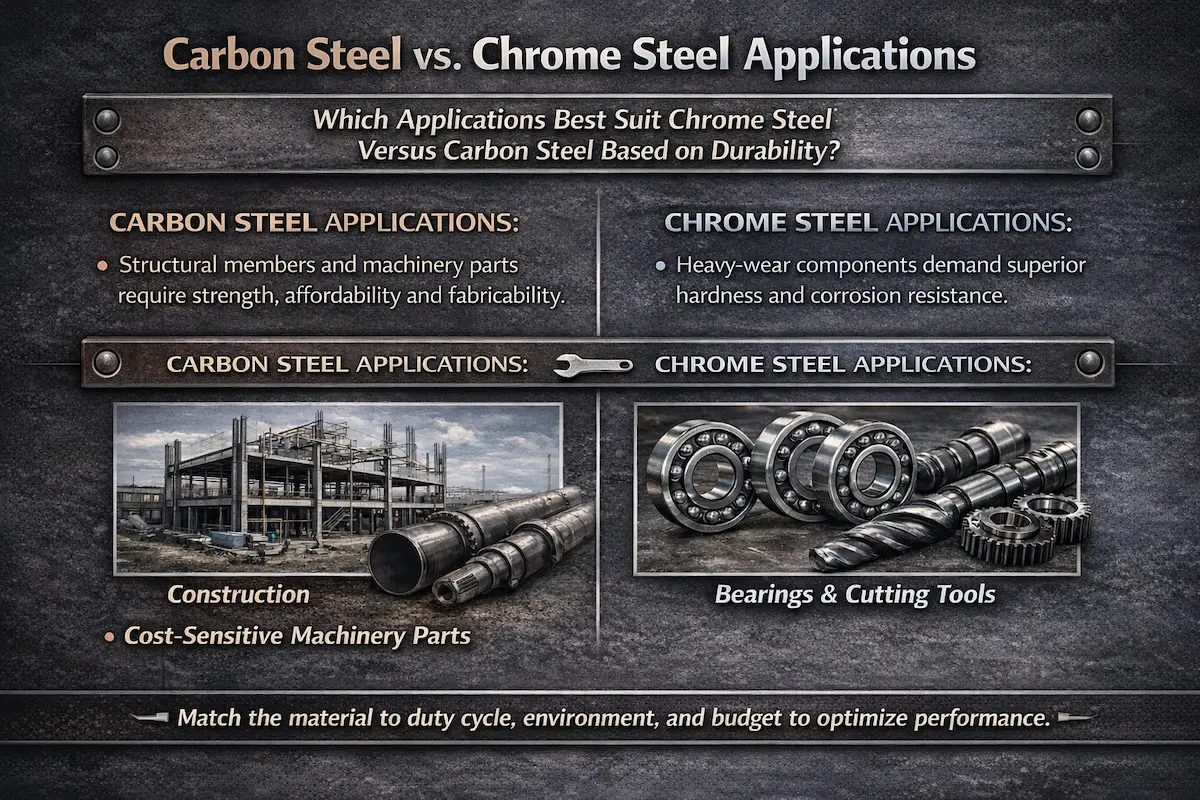
Picking between chrome steel and carbon steel balls is usually framed as a price question. In practice it is a question of how long the ball will last in your application, and how it will fail when it does. This article looks at durability: how each material wears, what happens under fatigue, impact, corrosion and heat, and what you can do to get more service life from either one. If you are still deciding which material to specify, start with our guide to choosing chrome steel vs carbon steel balls.
Why the hardening method matters more than the name
The biggest durability difference between the two is not the alloy itself but how each ball is hardened.
- Chrome steel balls (AISI 52100) are through-hardened. The ball is hard from surface to core, so wear, polishing and minor surface damage expose more hard steel underneath.
- Carbon steel balls are usually case-hardened. A hard outer shell sits on a softer core. The ball performs well while the shell is intact; once it is worn or crushed through, the soft core wears quickly.
That single difference explains most of what follows.
Wear: gradual vs sudden
Chrome steel balls wear slowly and evenly. Their size and roundness drift very little over long running hours, which is why they are used where accuracy must be held over time.
Carbon steel balls also resist surface wear well at first. The risk is the end of life: when abrasive contamination or sustained load wears through the case, wear accelerates sharply. In light-duty hardware this may take years; under heavy load it can happen quickly.
Rolling contact fatigue and spalling
Under repeated rolling loads, steel eventually fatigues below the surface and small flakes break away (spalling). Through-hardened chrome steel is designed for exactly this kind of loading and offers far longer fatigue life at high loads and speeds. A case-hardened ball can develop fatigue cracks at the boundary between the hard case and soft core when loads exceed what it was designed for. For continuous or heavy rolling loads, chrome steel is the durable choice.
Impact and denting
Shock loads behave differently. A through-hardened chrome steel ball resists denting, but it is hard throughout and can chip or crack under severe impact. A carbon steel ball’s softer core absorbs some shock, although a heavy blow can dent the case and leave a flat spot that makes the ball run rough. Where impact is frequent, describe it when you request a quote; it affects the material and grade recommendation.
Corrosion and storage
Neither material is corrosion resistant. Chrome steel contains only about 1.5% chromium, far below the roughly 10.5% that makes steel stainless. Rust is more than a cosmetic problem: corrosion pits act as starting points for fatigue cracks and shorten service life considerably.
- Keep balls in their original oiled packaging until use.
- Store them in a dry area and avoid handling with bare hands, which leaves corrosive residue.
- For wet, washdown or chemical environments, consider stainless steel or ceramic balls rather than relying on oil alone.
Heat
Both materials lose hardness as operating temperature rises, and high temperatures can also cause slow, permanent size change in hardened steel. Standard chrome steel balls are well suited to normal machinery temperatures. For continuous service in hot environments, tell us the operating temperature so we can recommend a suitable material, such as stainless steel or ceramic.
Signs a steel ball has reached end of life
| What you see | Likely cause | What to consider |
|---|---|---|
| Flaking or pitted surface | Rolling contact fatigue | Higher load rating or chrome steel |
| Dull, worn surface; looser fit | Abrasive wear or contamination | Better sealing or lubrication; through-hardened balls |
| Flat spots or dents; rough running | Impact or overload | Reduce shock loads; review material choice |
| Rust spots or staining | Moisture exposure | Better storage and lubrication, or stainless / ceramic |
| Cracks or chipped balls | Severe impact on a hard ball | Review the impact loads with your supplier |
How to get more life out of either material
- Match the material to the load. Do not run case-hardened balls in heavy, continuous duty.
- Specify the right grade. Mixed or out-of-tolerance balls share load unevenly and fail early; see bearing ball grades explained.
- Keep it lubricated and clean. Contamination is one of the most common causes of premature wear.
- Protect against moisture in storage and in service.
- Replace balls as a set in precision assemblies so new and worn balls do not share the load.
Durability at a glance
| Durability factor | Chrome steel balls | Carbon steel balls |
|---|---|---|
| Long-term wear | Slow and even | Good until the case wears through |
| Fatigue under heavy load | Excellent | Limited |
| Impact | Resists denting; can chip under severe shock | Soft core absorbs shock; case can dent |
| Corrosion | Low; needs oil or protection | Low; often plated or oiled |
| Best suited to | High load, high speed, long running hours | Light, intermittent, cost-sensitive duty |
Frequently Asked Questions
Which lasts longer, chrome steel or carbon steel balls?
Under load, chrome steel balls last considerably longer because they are hard all the way through. In light-duty applications, carbon steel balls often last the life of the product at a lower cost.
Why did my carbon steel balls wear out suddenly?
Most likely the hardened outer case wore or was crushed through, exposing the softer core. That points to a load, contamination or impact level better suited to chrome steel.
Does chrome steel need lubrication?
Yes. Lubrication reduces wear and protects against rust, which chrome steel does not resist on its own.
How should steel balls be stored?
Keep them in their oiled packaging in a dry place and handle them with gloves. Corrosion pits that form in storage shorten service life once the balls are in use.
Want a second opinion on what failed, or which material will last in your application? Contact us or request a quote with your load, speed and operating environment.
Related reading: Carbon Steel: Characteristics and Industry Applications · What Is Chrome Steel? Key Properties and Applications