
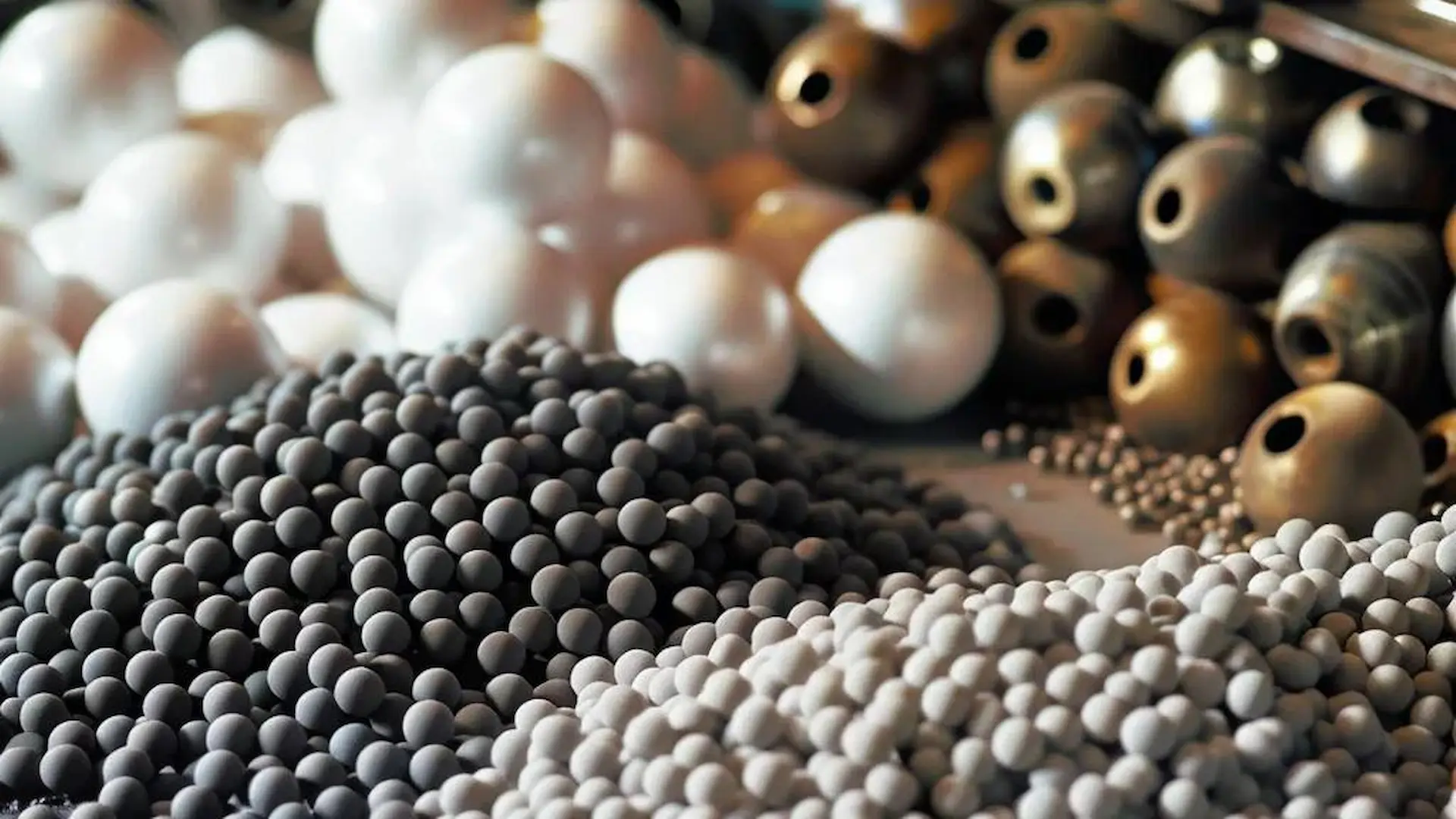

Choosing the wrong grinding media costs money twice: once in the purchase, and again in lost throughput, contamination, and premature media replacement. This guide walks through the media types that matter, the properties that drive performance, and a practical selection process you can apply to any milling operation, from mining ball mills to pharmaceutical stirred media mills.
STR Industries manufactures steel and glass grinding media in-house, finishes tungsten carbide media in-house from purchased blanks to your order, and supplies ceramic media in compositions matched to the application, in sizes from 1/64 inch to 6 inches in virtually any increment, under ISO 9001 and TS 16949 certified quality systems. The selection principles below are the same ones our engineers use when specifying media for a customer application.
The Main Types of Grinding Media
Grinding media are the solid bodies inside a mill that reduce particle size through impact and attrition. Shape, material, and density determine how energy is transferred to the feed, how much contamination enters the product, and how long the media lasts.
Steel grinding balls
Steel balls are the workhorse of heavy-duty milling. Through-hardened chrome steel (typically AISI 52100) reaches 60 to 67 HRC with a density of about 7.8 g/cm3, which delivers the high impact energy needed for coarse grinding of ores, clinker, and minerals. Forged carbon and alloy steel balls trade a few points of hardness for toughness and lower cost, making them the standard charge in mining ball mills and SAG mills. Stainless grades, such as 440C at 58 to 63 HRC and about 7.75 g/cm3, add corrosion resistance for wet milling where rust contamination is a concern.
Typical applications: mining and mineral processing, cement, general industrial pulverizing, and burnishing and mass finishing, where steel balls also serve as burnishing media for deburring and surface finishing of metal parts.
Ceramic grinding balls and beads
Ceramic media combine high hardness with chemical inertness, which keeps metallic contamination out of the product. The two dominant ceramics are alumina (Al2O3) and zirconia (ZrO2):
- Alumina: 92% alumina runs about 3.6 g/cm3 and 99% alumina about 3.9 g/cm3, both at Mohs 9. A cost-effective choice for general ceramic milling, paints, and minerals.
- Zirconia: yttria-stabilized zirconia (YTZ) reaches about 6.0 to 6.1 g/cm3 at Mohs 8.5, with exceptional fracture toughness. The standard for contamination-free fine and ultra-fine milling in pharmaceuticals, food, inks, and electronic materials.
- Silicon nitride (Si3N4): about 3.2 g/cm3 with very high hardness and fracture toughness. Used where extreme wear resistance and thermal stability matter, such as advanced ceramics and aerospace components.
The ceramic composition and purity are matched to the application and confirmed at quotation: send your process requirements and we will specify the right formulation. Our ceramic ball manufacturing page covers grades, sizes, and material options in detail.
Glass beads
Soda-lime and borosilicate glass beads, at about 2.5 g/cm3 and Mohs 6, are the gentle option. They produce fine dispersions without introducing metal ions, which is why they dominate pigment, dye, ink, and coating mills where color purity and low contamination matter more than impact energy.
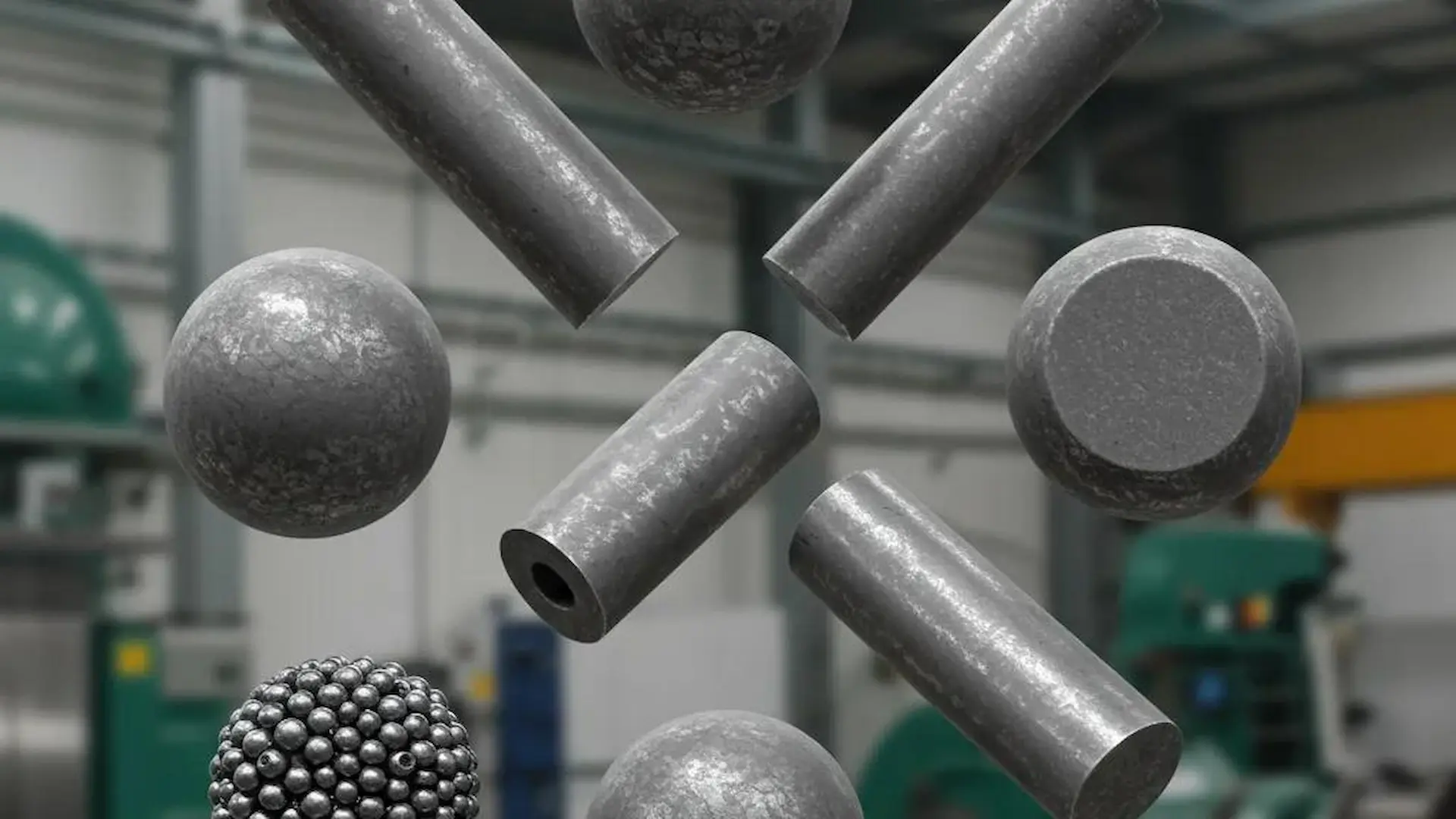
Cylpebs
Cylpebs are short cylinders with rounded edges. Their flat contact surfaces increase the grinding surface area compared with spheres of the same mass, which suits them to fine grinding of cement clinker and minerals in ball mills. They are typically made from high-chrome cast iron or forged steel.
Specialty and high-density media
For extreme duty, cemented tungsten carbide media reach 14.3 to 15.0 g/cm3 at Mohs 9 to 9.5, the highest density of any common media, suited to ultra-fine milling of very hard or abrasive feed. Silicon carbide (about 3.2 g/cm3, Mohs 9+) and natural agate serve niche laboratory and contamination-free applications.
How to Choose Grinding Media: The Selection Criteria
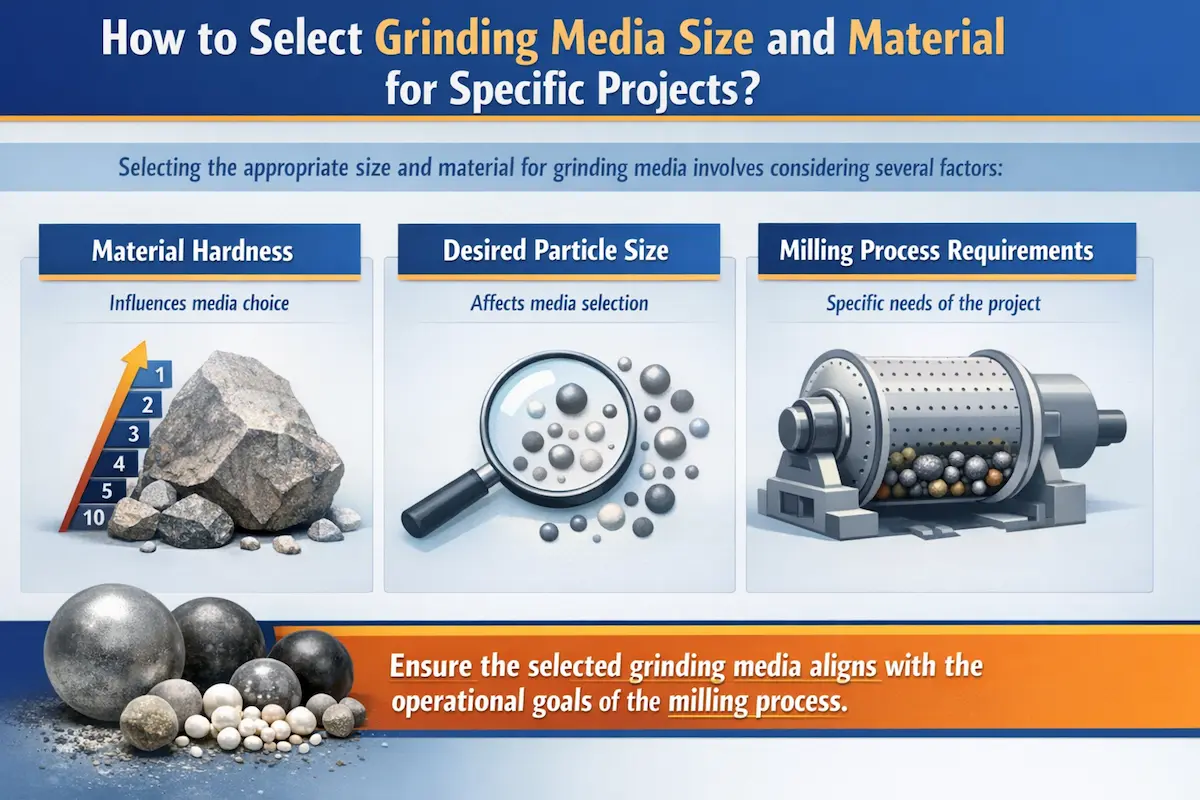
Work through these six criteria in order. Each one narrows the field until the right material and size remain.
1. Material compatibility and contamination limits
Start with what the product will tolerate. If the specification limits iron, chromium, or other metal ions, as in pharmaceuticals, food, white pigments, or battery materials, steel is out and ceramic or glass media are required. If the feed is an abrasive mineral ore with no purity constraint, steel is usually the economical answer.
2. Target particle size
Media diameter should scale with the feed size and the target fineness. Coarse grinding (above roughly 100 microns) calls for large steel balls, 20 to 50 mm, that deliver high impact per collision. Intermediate grinding (10 to 100 microns) suits 10 to 20 mm media or cylpebs. Ultra-fine grinding (below 10 microns) needs small ceramic beads, typically 0.5 to 5 mm, where high surface area and attrition do the work. A common rule of thumb: the media should be roughly 20 to 30 times the diameter of the largest feed particles.
3. Density and impact energy
Density sets the kinetic energy of each collision. Steel at 7.8 g/cm3 hits far harder than glass at 2.5 g/cm3 at the same mill speed, which is why steel dominates coarse, high-throughput grinding. In stirred and attrition mills running at high tip speeds, zirconia at 6.0 g/cm3 delivers strong energy without the contamination risk of steel. Match density to the job: enough energy to break the feed, not so much that you waste power over-grinding it.
4. Hardness and wear life
Harder media wear slower and hold their diameter longer, which keeps the mill charge stable and product quality consistent. Through-hardened chrome steel at 60 to 67 HRC, alumina at Mohs 9, and tungsten carbide at Mohs 9 to 9.5 all resist abrasive wear well. But hardness alone is not enough: the media must also be tough enough to survive impact without fracturing, which is why forged steel and stabilized zirconia outperform brittle alternatives in high-energy mills.
5. Mill type compatibility
| Mill type | Preferred media | Why |
|---|---|---|
| Ball mill | Steel balls, cylpebs | Impact-dominated; coarse to intermediate range |
| Stirred media mill | Ceramic beads (alumina, zirconia) | Attrition-dominated; ultra-fine powders |
| SAG mill | Forged steel balls | High load, autogenous action with large feed |
| Vibratory mill | Steel or ceramic, sized to chamber | Low-amplitude, high-frequency motion |
| Attritor / bead mill | Small ceramic or glass beads | Fine dispersions, pigments, inks |
6. Total cost, not purchase price
Ceramic beads cost more per kilogram than steel, but in abrasive or contamination-sensitive service they can outlast steel by a wide margin while eliminating product rework. Evaluate media on cost per ton ground, including replacement frequency, downtime for media change-outs, energy consumption, and contamination-related scrap. The cheapest media per pound is rarely the cheapest media per ton of finished product.
Steel vs. Ceramic: When Each Wins
This is the most common decision in grinding media selection, so it deserves a direct comparison.
| Attribute | Steel balls | Ceramic balls |
|---|---|---|
| Density | ~7.8 g/cm3 | 3.6 to 6.1 g/cm3 (alumina to zirconia) |
| Hardness | 60 to 67 HRC (chrome steel) | Mohs 8.5 to 9 |
| Impact toughness | Excellent | Good (zirconia best in class) |
| Contamination | Iron/chromium wear debris | Minimal; no metallic ions |
| Corrosion resistance | Low (stainless grades better) | Excellent |
| Purchase cost | Lower | Higher |
| Best for | Mining, cement, coarse grinding | Pharma, food, pigments, ultra-fine milling |
Choose steel when impact energy, throughput, and purchase cost dominate the decision. Choose ceramic when product purity, wear life in corrosive slurries, or ultra-fine particle targets dominate. For a deeper material-by-material breakdown, see our grinding media materials and properties comparison.
Media Selection by Industry
Mining and mineral processing
Forged and high-chrome steel balls dominate. The feed is coarse and highly abrasive, contamination limits are loose, and throughput is everything. Ball and SAG mills run steel charges from 25 mm to over 100 mm.
Cement
A blend of forged steel balls and cylpebs. Cylpebs add grinding surface for consistent clinker fineness while steel balls handle the high-load impact duty.
Pharmaceuticals and food
High-purity alumina or yttria-stabilized zirconia beads. Chemical inertness and near-zero metallic contamination are non-negotiable, and the media must survive cleaning and sterilization regimes.
Paints, pigments, and inks
Glass beads or zirconia, depending on fineness targets. Glass gives gentle, contamination-free dispersion for color-critical products; zirconia steps in for finer grinds and higher throughput.
Advanced ceramics and electronics
Zirconia, silicon nitride, or high-purity alumina. The media must be harder than the feed and chemically inert to protect dielectric, magnetic, and structural ceramic properties.
Sizing, Grades, and Standards
Precision grinding media are specified by diameter, grade, and material standard. Steel balls follow ISO 3290 (Part 1 for steel balls, Part 2 for ceramic balls) and DIN 5401, which define ball grades from G3 to G200 covering diameter variation, sphericity, and surface roughness. Tighter grades mean more uniform media, more predictable mill behavior, and less out-of-spec product.
STR Industries manufactures grinding media from 1/64 inch to 6 inches in diameter, in virtually any increment. Tolerances vary by material, size, grade, and application requirements: send us your specification and we will confirm the tolerance we can hold for your order. Learn how our ball manufacturing process controls grade and finish, or explore the full grinding media range covering chrome steel, stainless steel, alumina, zirconia, glass, and tungsten carbide. When you are ready to buy, our grinding media supplier page explains the procurement process.
Media Size, Charge Level, and Charge Management
Selecting the material is half the job. How much media you load, what size, and how you maintain the charge determines day-to-day performance.
Choosing media diameter
| Grinding stage | Typical media diameter | Common materials |
|---|---|---|
| Coarse primary grinding | 50 to 100 mm | Forged steel, high-chrome cast iron |
| Secondary ball milling | 20 to 50 mm | Chrome steel, forged steel |
| Regrind and fine grinding | 10 to 25 mm | Chrome steel, cylpebs |
| Stirred mill, ultra-fine | 1 to 6 mm | Zirconia, alumina |
| Bead mill dispersion | 0.5 to 3 mm | Glass, zirconia |
Use a single size for coarse impact duty and a graded or mixed charge for intermediate duty, where large balls break coarse particles and small balls polish the fines. Avoid charges with widely mixed sizes in high-impact mills, because large balls hammer small ones and accelerate their wear.
Charge level and top-up
Ball mills typically run at 30 to 40 percent of mill volume in media. As media wear, the charge level drops, the remaining balls travel farther before impact, and energy per ton rises. Most plants top up on a fixed schedule based on measured wear, pulling and weighing samples or tracking power draw against throughput. Replace the charge when the average ball diameter falls below the size that effectively grinds the coarsest feed, since worn, undersized media grind slowly and consume power without producing product.
Steel Balls in Burnishing and Mass Finishing
Steel balls do double duty beyond milling. In burnishing and mass finishing, chrome steel and stainless balls polish, deburr, and work-harden metal parts in vibratory and barrel finishing equipment. The same properties that make them good grinding media, hardness, sphericity, and consistent diameter, produce uniform surface finishes without cutting or removing material. Burnishing media are typically specified by grade and surface finish rather than by wear rate, and stainless grades suit parts where rust staining is a concern. See our steel ball manufacturing page for grades used in finishing applications.
Common Selection Mistakes
- Choosing on price per pound. The relevant number is cost per ton ground, including wear life and downtime.
- Oversizing the media. Balls much larger than the feed waste energy and produce coarse, wide particle distributions.
- Ignoring contamination. Steel wear debris in a white pigment or pharma batch can scrap the entire lot. Specify inert media where purity matters.
- Mixing incompatible media. Hard steel balls will rapidly wear softer ceramic or glass beads sharing the same charge.
- Running worn media too long. As media shrink, grinding efficiency falls and energy per ton rises. Monitor charge level and top up on schedule.
Frequently Asked Questions
What is the most common grinding media material?
Steel, by a wide margin. Forged and chrome steel balls dominate mining, cement, and general industrial milling because they combine high density, high hardness, and low cost. Ceramic media lead only in contamination-controlled and ultra-fine applications.
How often should grinding media be replaced?
There is no universal interval. It depends on feed abrasiveness, mill energy, and media material. Monitor charge level and average ball diameter: when the charge falls below the target fill or the balls shrink past the effective size for the feed, top up or recharge.
Can different media materials be mixed in one mill?
Generally no. Hard steel balls will rapidly destroy softer glass or ceramic beads in the same charge, and mixed densities cause segregation. Run one material per mill, and change over fully when switching.
Does smaller media always grind finer?
Smaller media produce finer product at a given energy input because they multiply contact points, but they also reduce impact per collision. Match media size to the feed: too small and coarse particles pass unground; too large and energy is wasted.
Request a Grinding Media Recommendation
Selecting grinding media involves trade-offs between energy, wear, contamination, and cost that depend on your specific mill, feed, and product specification. STR Industries has manufactured precision balls and grinding media for more than 30 years, and our engineers specify media for mining, cement, pharmaceutical, pigment, and advanced ceramic applications every week.
Request a quote with your mill type, feed material, target particle size, and current media, and we will recommend the material, size, and grade that fits, including custom sizes and application-matched material selection where standard media fall short.