
Precision Ceramic Balls
Precision Ceramic Balls for High-Temperature, Corrosive, and Non-Conductive Applications
STR Industries supplies zirconia, silicon nitride, and alumina ceramic balls for bearings, valves, pumps, grinding media, medical devices, aerospace components, and industrial systems where steel is not the right fit.
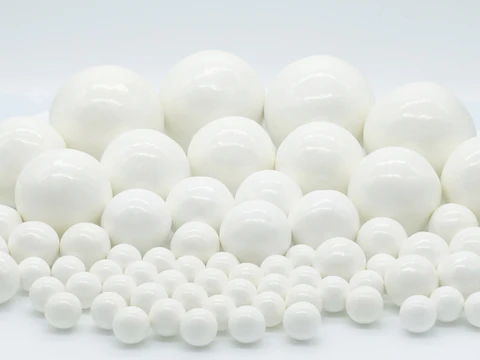
Ceramic vs. Steel
When Steel Is Not the Right Material, Ceramic Solves the Application Problem
Ceramic balls are specified when the application requires high-temperature capability, corrosion resistance, electrical insulation, non-magnetic performance, low weight, or contamination control.
| When to Specify Ceramic | Why Ceramic Outperforms Steel |
|---|---|
| Operating temperature above 300°C | Silicon nitride and alumina retain performance at temperatures where steel can lose temper and dimensional stability. |
| Corrosive chemical environment | Ceramic materials offer strong resistance to many acids, bases, solvents, and washdown environments. |
| Electrical insulation required | Ceramic balls are non-conductive, helping prevent current paths in motor bearings and precision assemblies. |
| Weight reduction is critical | Silicon nitride is significantly lighter than steel, reducing centrifugal force and rotational inertia in high-speed bearings. |
| Non-magnetic performance required | Ceramic balls are non-magnetic, making them useful in sensors, medical equipment, precision instruments, and specialty devices. |
| Contamination-sensitive process | Ceramic balls do not shed metal particles, helping reduce contamination in food, pharmaceutical, pigment, ink, and chemical processes. |
Material Comparison
Compare Zirconia, Silicon Nitride, and Alumina Ceramic Balls
The right ceramic material depends on temperature, density, hardness, fracture toughness, corrosion exposure, cost target, and application type.
| Property | Zirconia ZrO2 | Silicon Nitride Si3N4 | Alumina Al2O3 99.5% |
|---|---|---|---|
| Density | 6.05 g/cm3 | 3.20 g/cm3 | 3.90 g/cm3 |
| Hardness | 1200-1300 HV | 1500-1700 HV | 1700-1900 HV |
| Compressive Strength | 2000 MPa | 3500 MPa | 2500 MPa |
| Flexural Strength | 900-1200 MPa | 700-1000 MPa | 350-450 MPa |
| Fracture Toughness | 8-10 MPa m1/2 | 6-8 MPa m1/2 | 3-4 MPa m1/2 |
| Max Operating Temperature | 1000°C | 1200°C | 1500°C |
| Thermal Expansion | 10.3 x 10^-6/K | 3.2 x 10^-6/K | 8.4 x 10^-6/K |
| Thermal Conductivity | 2.5 W/m K | 30 W/m K | 30 W/m K |
| Electrical Resistivity | >10^14 ohm cm | >10^13 ohm cm | >10^14 ohm cm |
| Corrosion Resistance | Excellent | Excellent | Excellent |
| Magnetic | No | No | No |
| Typical Relative Cost | Medium | Highest | Lowest |
Material Selection Guide
Choose the Ceramic Ball Material Based on the Application
Each ceramic material has a different performance profile. Use zirconia for toughness and chemical resistance, silicon nitride for high-speed bearing performance, and alumina for cost-sensitive wear and grinding applications.
Zirconia ZrO2
Best for: Chemical resistance, toughness, valves, pumps, and contamination-sensitive applications.
- Industrial ball valves in corrosive environments
- Non-magnetic precision instrument bearings
- Medical and dental device components
- Pump and metering equipment
- Food processing where metal contamination must be avoided
Silicon Nitride Si3N4
Best for: Hybrid bearings, high-speed rotation, low weight, and electrical insulation.
- Hybrid ceramic bearings with steel races
- Aerospace and defense bearing applications
- Electric motor and EV motor bearings
- Machine tool spindles and high-RPM systems
- High-temperature equipment and turbine-related assemblies
Alumina Al2O3
Best for: Grinding media, wear resistance, chemical resistance, and lower relative cost.
- Grinding media for paint, pigment, and ink manufacturing
- Wear-resistant valve components
- Cost-sensitive corrosion-resistant applications
- Laboratory and analytical equipment
- Thermal-cycle and high-temperature equipment
Tolerance Grades and Size Range
Ceramic Ball Tolerances for Bearings, Valves, Grinding Media, and Specialty Components
Ceramic balls can be produced to bearing-grade tolerances, but achievable grades vary by material, size, and application. Submit the drawing or specification to confirm feasibility.
| Material | Standard ABMA Grades | Common Size Range | Common Use |
|---|---|---|---|
| Zirconia ZrO2 | Grade 5 - Grade 25 | 0.5 mm through 50 mm | Precision bearings, valves, pumps, medical devices, and corrosion-resistant components. |
| Silicon Nitride Si3N4 | Grade 3 - Grade 10 | 1 mm through 40 mm | Hybrid bearings, high-speed spindles, electric motor bearings, and aerospace components. |
| Alumina Al2O3 | Grade 25 - Grade 1000 | 0.8 mm through 80 mm | Grinding media, wear components, valves, laboratory equipment, and industrial processing. |
Applications by Industry
Ceramic Balls for Bearings, Grinding Media, Valves, Pumps, and Specialty Equipment
Ceramic ball selection depends on temperature, corrosion exposure, electrical insulation, magnetic requirements, contamination risk, and speed.
Hybrid Bearings
Typical material: Silicon nitride Si3N4.
Used in high-speed spindles, electric motors, aerospace bearings, and precision rotating equipment.
Grinding Media
Typical material: Zirconia or alumina.
Used for paint, pigment, ink, chemical, food, pharmaceutical, and particle-size-reduction processes.
Valves and Pumps
Typical material: Zirconia, alumina, or silicon nitride.
Used in check valves, ball valves, flow meters, metering pumps, and corrosive chemical systems.
Medical and Dental
Typical material: Zirconia or alumina.
Used in medical devices, dental components, instruments, pumps, and contamination-sensitive assemblies.
Aerospace and Defense
Typical material: Silicon nitride Si3N4.
Used where low weight, electrical insulation, high-speed capability, and thermal stability are required.
Food and Pharmaceutical
Typical material: Zirconia or alumina.
Used where corrosion resistance, washdown compatibility, and metal-contamination avoidance are priorities.
Certifications and Documentation
Material Certifications and Inspection Documentation for Ceramic Ball Orders
STR Industries supports ceramic ball orders with material certificates, dimensional inspection reports, lot traceability, and compliance documentation when specified on the RFQ.
Common Documentation Requests
- Certificate of Conformance
- Material certificate or material data sheet
- Dimensional inspection report
- Surface finish or tolerance verification
- RoHS or REACH compliance documentation
- Lot traceability documentation for medical, aerospace, or industrial customers
Request a Quote
Request a Ceramic Ball Quote
Upload your drawing, datasheet, part number, or written specification. Include ceramic material, diameter, tolerance class, quantity, application, temperature, chemical exposure, and documentation requirements.
Request for Quote
FAQ
Ceramic Ball Questions
Are ceramic balls more expensive than steel?
Yes. Ceramic balls generally cost more per unit than equivalent steel balls. However, in high-speed, high-temperature, corrosive, electrically sensitive, or contamination-sensitive applications, ceramic balls may reduce downtime, wear, and maintenance.
What is a hybrid ceramic bearing?
A hybrid ceramic bearing uses ceramic balls, typically silicon nitride, with steel inner and outer races. This construction can reduce friction, reduce weight, improve electrical insulation, and extend bearing life in the right application.
Can ceramic balls handle shock loads?
Ceramic balls have high compressive strength but lower fracture toughness than steel. They perform well under steady loads but can crack under sudden impact. For shock-load applications, silicon nitride is often preferred over alumina.
Which ceramic is best for electric motor or EV motor bearings?
Silicon nitride is commonly specified for electric motor and EV motor bearing applications because it is lightweight, hard, electrically insulating, and suitable for high-speed hybrid bearing assemblies.
Are ceramic balls suitable for food-grade applications?
Yes. Ceramic balls are chemically resistant, corrosion resistant, and do not shed metal particles. Zirconia and alumina are commonly considered for food processing and contamination-sensitive equipment. Confirm any required food-contact documentation on the RFQ.
Does STR Industries supply ceramic balls to ISO 3290 specifications?
Yes. Ceramic balls may be specified to ISO 3290-2 tolerance requirements. Include the ISO grade, ABMA grade, drawing, or dimensional requirements on the RFQ.
Which ceramic material is best for grinding media?
Zirconia and alumina are commonly used for ceramic grinding media. Zirconia is selected where high density and wear resistance are required, while alumina is often used when corrosion resistance and cost control are important.
What information should I include in a ceramic ball RFQ?
Include material, diameter, tolerance grade, quantity, application, operating temperature, chemical exposure, speed, load, and documentation requirements. A drawing or datasheet is preferred when available.
Specifying Ceramic Balls for a Critical Application?
Send your specification or describe your application. STR Industries will review the material, diameter, tolerance, quantity, operating environment, and documentation requirements.
Request a Ceramic Ball Quote