

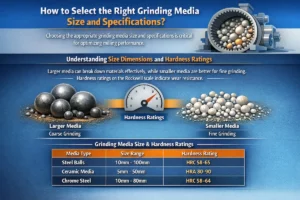
Choosing the wrong grinding media costs money twice: once in the purchase, and again in lost throughput, contamination, and premature media replacement. This guide walks through the media types that matter, the properties that drive performance, and a practical selection process you can apply to any milling operation, from mining ball mills to pharmaceutical stirred…
Grinding Media Supplier | Custom Sizes & Materials | STR Industries
STR Industries supplies precision grinding media for milling operations that cannot compromise on size consistency, material quality, or contamination control. We manufacture steel and glass media in-house, finish tungsten carbide media in-house from purchased blanks to your order, and supply ceramic media in compositions matched to the application. Sizes run from 1/64 inch to 6…

Grinding Media Materials & Properties: The Complete Comparison
Every grinding media decision comes down to material properties. Density sets impact energy. Hardness sets wear rate. Chemistry sets contamination risk. This guide compares the materials engineers actually specify, steel, stainless, alumina, zirconia, silicon nitride, glass, and tungsten carbide, with verified property data so you can match the material to the process. For the step-by-step…
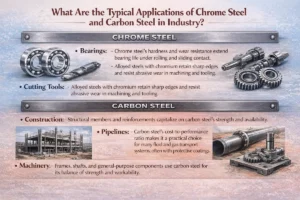
Chrome Steel vs. Carbon Steel — Key Differences and Industrial Uses
Choosing the right steel for industrial work starts with understanding how chrome (chromium-alloyed) steel and carbon steel differ. Though both are steels, their chemistry, mechanical behavior, and typical applications diverge in ways that matter for performance, cost, and part life. This article compares composition, properties, heat treatment, corrosion resistance, and common uses so you can…
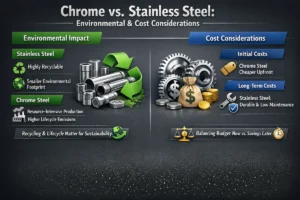
Chrome Steel vs Stainless Steel — Clear Differences and Which to Choose
Picking the right steel for industrial work means understanding how chrome steel and stainless steel behave in the field. Both alloys bring useful traits, but their performance, durability, and cost can vary a lot depending on the application. This article compares the two steels across composition, corrosion resistance, durability, common uses, and upkeep. Read on to…
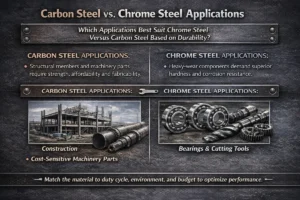
Chrome Steel vs Carbon Steel: Comprehensive Durability Comparison and Performance Insights
Choosing between chrome steel and carbon steel is a key decision for construction and manufacturing projects. Each alloy brings distinct characteristics that affect durability, performance, and cost. This article breaks down their compositions, mechanical behavior, and typical applications so you can match material to requirement. You’ll get practical insight into how these steels behave in…

Choosing the Right Media for Industrial Milling Applications
Grinding media are spherical or shaped components used in mills to reduce particle size, transfer energy, and achieve controlled comminution. The choice between steel and ceramic grinding media involves balancing impact energy, wear behavior, contamination tolerance, and total cost of ownership (TCO). Steel media provide high density and toughness for impact-driven size reduction, while ceramic media are selected…

Beware of Supply Chain Shortfalls: Why Cutting Corners Can Cost You More
In today’s global economy, sourcing quality components isn’t just a procurement task—it’s a strategic necessity. Yet under mounting pressure to reduce costs or meet tight deadlines, many businesses take shortcuts in their supply chains. Unfortunately, what looks like a money-saving decision up front can end up costing far more down the line. At STR Industries,…
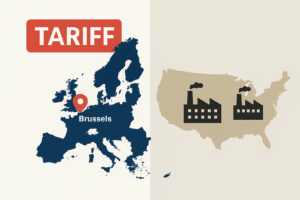
Why a 50% Tariff on European Goods Is a Strategic Win for American Manufacturing
America’s manufacturing sector has been under pressure for decades. Cheap imports, unfair trade advantages, and foreign subsidies have tilted the playing field, especially regarding goods from Europe. But what if a bold, decisive move like a 50% tariff could turn the tide?In this post, we’ll break down why a 50% tariff on European imports is…
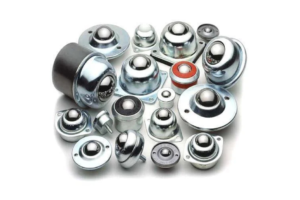
How STR Industries Supplies Custom Ball Transfer Units for Tough Industrial Environments
If you’re sourcing components for aerospace systems, airport cargo platforms, or material handling in food or chemical environments, you already know: off-the-shelf doesn’t always cut it. At STR Industries, we don’t just move boxes — we help engineers move the world, one load-bearing unit at a time. This is why we supply custom ball transfer…