
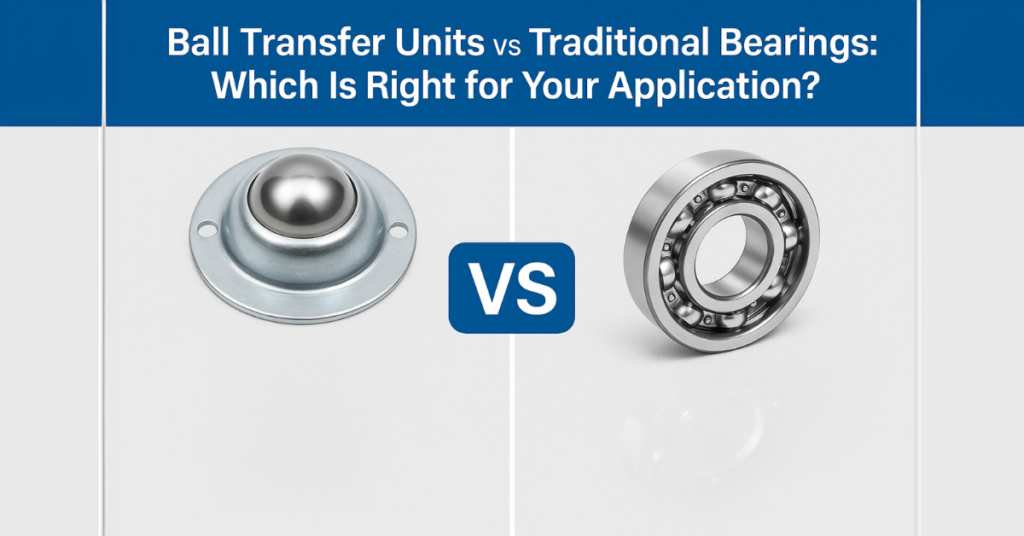
Ball Transfer Units vs. Traditional Bearings: Which Is Right for Your Application?
If you’re designing a material handling system or planning a mechanical upgrade, the type of bearing you choose makes all the difference. While traditional bearings — like linear or radial bearings — are essential in many designs, ball transfer units (BTUs) offer a unique advantage when you need multi-directional movement.
So, which one is right for your application? Let’s break it down.
The Basics: How They Function
Ball Transfer Units
BTUs are built to allow items to move freely in any direction. A large main ball sits on top of smaller internal balls, all housed in a steel or plastic shell. The design lets you push, turn, and shift a load in any orientation without lifting.
Traditional Bearings
Traditional bearings — whether ball, roller, or linear — support movement along a single axis (either rotational or linear). They’re commonly used in machinery, motors, wheels, and shafts where controlled, continuous motion is required.
Key Differences at a Glance
| Feature | Ball Transfer Units | Traditional Bearings |
|---|---|---|
| Movement | Multi-directional (360°) | Single axis (rotational or linear) |
| Best For | Material handling, flat-surface positioning | Rotating shafts, linear guides, wheels |
| Load Handling | High point load capacity | Continuous motion and rolling efficiency |
| Installation | Simple surface mount, recessed or threaded | Requires shaft, rail, or guide system |
| Common Applications | Conveyor tables, airports, packaging lines | Motors, fans, gearboxes, slides, rail guides |
When to Use Ball Transfer Units
BTUs are best for applications that involve:
- Moving flat-bottomed items (boxes, panels, pallets)
- Positioning loads in different directions without lifting
- Creating low-friction, ergonomic surfaces for workers
- Reducing force required to push heavy loads
- Designing adjustable conveyors or transfer stations
Examples include:
- Baggage handling systems
- Sheet metal processing
- Sliding platforms and gates
- Pallet docks
- Robotics platforms
When Traditional Bearings Are the Better Fit
Go with traditional ball or roller bearings when you need:
- Continuous rotational motion (e.g., shafts, pulleys, wheels)
- Controlled linear movement (e.g., CNC, robotic arms)
- High-speed or precision rolling
- Torque management
Examples include:
- Conveyor rollers
- Electric motors
- Medical or lab automation systems
- Sliding drawers and telescopic guides
- Pump and gear assemblies
Choosing Between the Two
Here’s how to decide:
- Do I need rotation or free movement in all directions?
→ Use BTUs for multi-directional surfaces - Is my system motor-driven or continuous?
→ Use traditional bearings - Am I designing a work surface or a transport system?
→ Use BTUs to reduce friction and manual strain - Is my load dynamic and precision-driven?
→ Stick with radial or linear bearings
Final Word
Ball transfer units aren’t here to replace traditional bearings — they solve a different problem. If your goal is to move, shift, or rotate heavy flat items across a surface with minimal effort, BTUs are the tool for the job.
But if you need precision rotation, shaft alignment, or powered movement, traditional bearings are still the gold standard.
📞 Ready to Spec the Right Part?
Whether you need pressed metal BTUs for a packaging station or stainless ball bearings for a motor rebuild, STR Industries has the expertise to guide your decision.
👉 Contact us now to get a quote or compare bearing types side-by-side.
Request a Quote
Related reading: How STR Industries Supplies Custom Ball Transfer Units for Tough Industrial Environments · Elevating Efficiency: STR Industries’ High-Precision Transfer Units
Frequently Asked Questions
What is the main difference between a ball transfer unit and a traditional bearing?
A ball transfer unit allows multi-directional, 360 degree movement: a large main ball sits on smaller internal balls inside a steel or plastic shell, so a load can be pushed, turned or shifted in any direction. Traditional ball, roller or linear bearings support movement along a single axis, either rotational or linear.
When should I use ball transfer units instead of bearings?
Ball transfer units suit applications that move flat-bottomed items such as boxes, panels or pallets, position loads in different directions without lifting, or create low-friction work surfaces that reduce the force needed to push heavy loads. Examples include baggage handling, sheet metal processing, pallet docks, sliding platforms and robotics platforms.
When are traditional bearings the better choice?
Traditional ball or roller bearings are the better fit for continuous rotational motion in shafts, pulleys and wheels, controlled linear movement such as CNC equipment or robotic arms, high-speed or precision rolling, and torque management. Typical uses include conveyor rollers, electric motors, pump and gear assemblies, and telescopic guides.
How are ball transfer units installed compared with bearings?
Ball transfer units use simple surface mounting, recessed or threaded. Traditional bearings require a shaft, rail or guide system to operate. That makes ball transfer units a practical choice for work surfaces, conveyor tables and transfer stations where loads move across a flat surface.