
Choosing the right steel for industrial work starts with understanding how chrome (chromium-alloyed) steel and carbon steel differ. Though both are steels, their chemistry, mechanical behavior, and typical applications diverge in ways that matter for performance, cost, and part life. This article compares composition, properties, heat treatment, corrosion resistance, and common uses so you can quickly identify which material fits your project requirements.
The key differences between chrome steel and carbon steel in industrial applications are as follows:
Chrome steel and carbon steel are distinguished mainly by their alloying elements and the properties those elements produce. Chromium in chrome steels raises hardness, wear resistance, and corrosion resistance. Carbon steels rely on carbon content for strength and formability, offering a wider range of mechanical balances and easier fabrication. Recognizing these trade‑offs is essential when specifying material for bearings, structural parts, or tooling.
What Are the Chemical Composition Differences Between Chrome Steel and Carbon Steel?
Chrome steel typically includes chromium in the range of about 0.5–2%, while carbon steel’s defining variable is carbon content, generally from roughly 0.05% to 1.5%. That chromium addition shifts microstructure and surface chemistry, improving hardness and oxidation resistance. By contrast, varying carbon is the primary lever for adjusting strength and ductility in plain carbon steels.
Adding alloying elements such as chromium to carbon steel is a standard metallurgical approach to tailor hardness, toughness, wear resistance, and other properties for targeted applications.
Carbon vs. Chromium Alloyed Tool Steels & Properties
Early tool steels were mostly plain carbon. Modern tool steels incorporate alloying elements — tungsten, vanadium, molybdenum, manganese, chromium, and others — to achieve combinations of wear resistance, toughness, machinability, and stability during heat treatment. No single composition optimizes every property, which is why a wide range of tool steels exists.
Tool steel material selection using PROMETHEE II method, SR Maity, 2015
How Does Chromium Content Affect Chrome Steel Properties?
Chromium strengthens chrome steel in two main ways: it increases hardness and wear resistance by promoting harder microstructures and carbides, and it forms a thin, protective oxide that improves corrosion resistance. Those attributes make chrome steel well suited for high‑wear components such as bearings, cutting edges, and demanding automotive parts exposed to friction and moisture.
What Role Does Carbon Content Play in Carbon Steel Characteristics?
Carbon controls the fundamental strength–ductility balance in carbon steel. Higher carbon raises hardness and tensile strength but reduces ductility and increases the risk of brittleness if not heat treated correctly. Material selection and proper heat treatment are therefore critical to achieve the desired combination of strength, toughness, and formability.
How Do Mechanical Properties Compare Between Chrome Steel and Carbon Steel?
Mechanical behavior differs predictably between the two: chrome steels generally show higher hardness and improved wear resistance, while carbon steels typically offer greater ductility and easier forming. Selecting between them depends on whether the application prioritizes wear life and corrosion resistance or toughness and fabrication flexibility.
What Are the Differences in Hardness and Tensile Strength?
Chrome steel hardness often falls in the 58–65 HRC range, whereas carbon steel commonly sits between 30–50 HRC, depending on carbon level and treatment. Tensile strength for chrome steel can exceed 200,000 psi in high‑performance grades; carbon steels typically range from about 50,000 to 120,000 psi. These figures illustrate chrome steel’s advantage for wear‑critical, high‑stress components.
Research confirms that chromium concentration is a decisive factor in final hardness and wear properties of alloyed steels.
Chromium’s Impact on Steel Hardness & Wear Resistance
Microstructural studies show chromium‑free alloys dominated by pearlite and ferrite with low hardness (e.g., ~18.8 HRC). As chromium increases, the matrix shifts toward martensitic structures and chromium‑rich borocarbides, producing much higher hardness and improved wear resistance. At 12 wt.% Cr, reported hardness reached about 61.1 HRC with the best wear performance.
Effect of chromium content on microstructure, hardness, and wear resistance of as-cast
Fe-Cr-B alloy, J Ju, 2019
How Does Heat Treatment Influence Carbon Steel Performance?
Heat treatment changes carbon steel’s microstructure and therefore its mechanical profile. Quenching and tempering raise hardness and strength; annealing softens the steel and improves ductility. Incorrect heat treatment can produce excessive brittleness or retained stresses, so process control is essential to achieve the intended performance.
Which Steel Type Offers Superior Corrosion Resistance and Durability?
Chrome steel delivers markedly better corrosion resistance than plain carbon steel because chromium promotes a stable oxide layer that limits rust and surface degradation. That makes chrome steel the go‑to where exposure to moisture, salts, or chemicals is expected. Carbon steel usually requires coatings, plating, or painting to reach comparable service life in corrosive conditions.
Multiple studies demonstrate a clear correlation between increased chromium content and improved corrosion resistance in steel alloys.
Chromium’s Role in Steel Corrosion Resistance
Overall corrosion resistance improves when chromium is added to steel, and the protection generally increases with higher chromium content.
A new understanding of the effect of Cr on the corrosion resistance evolution of weathering steel based on big data technology, X Cheng, 2022
How Does Corrosion Resistance Impact Industrial Applications?
Corrosion resistance affects maintenance intervals, replacement cycles, and total cost of ownership. In wet, chemical, or marine environments, choosing a chromium‑alloyed steel can cut downtime and extend part life, translating into real savings for operations and asset managers.
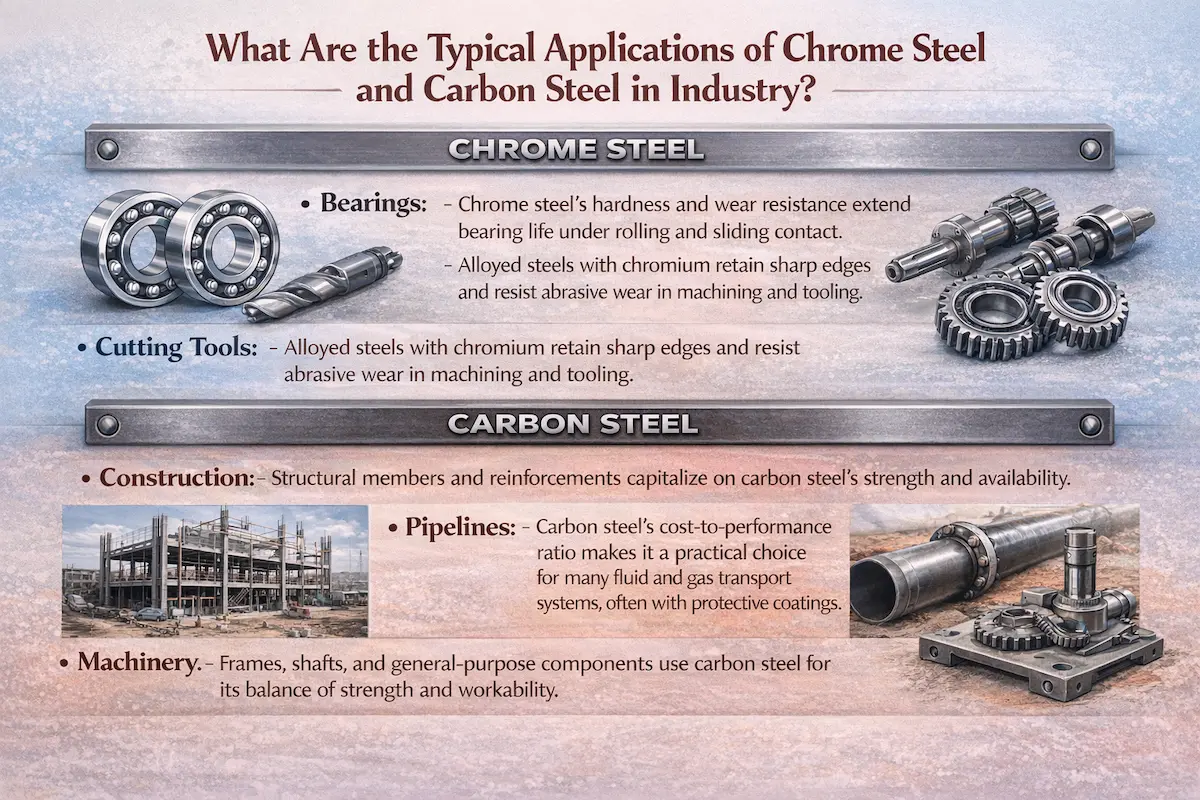
Industrial Applications: Chrome Steel vs. Carbon Steel
| Material | Key Applications | Primary Reasons for Use |
|---|---|---|
| Chrome Steel | Bearings: Rolling and sliding contact components. | High hardness and wear resistance extend the service life of the part. |
| Cutting Tools: Machining and industrial tooling. | Chromium allows the steel to retain sharp edges and resist abrasive wear. | |
| Automotive Components: High-stress engine or drivetrain parts. | Benefits from superior strength and surface durability. | |
| Carbon Steel | Construction: Structural members and reinforcements. | Capitalizes on the material’s high strength and widespread availability. |
| Pipelines: Fluid and gas transport systems. | Offers an excellent cost-to-performance ratio, though often requires protective coatings. | |
| Machinery: Frames, shafts, and general-purpose components. | Chosen for its optimal balance of physical strength and workability/fabrication ease. |
Which Industries Prefer Chrome Steel and Why?
Sectors that require long service life, dimensional stability, and resistance to wear and corrosion often choose chrome steel. Automotive and aerospace use chrome alloys in high‑stress components; medical and surgical instruments benefit from corrosion resistance and ease of sterilization. These industries rely on chrome steel where part failure is not an option.
Where Is Carbon Steel Commonly Used and What Are Its Advantages?
Carbon steel remains the default choice for many heavy industries due to its cost, availability, and ease of fabrication. It suits construction, general manufacturing, and many automotive applications where high strength and straightforward processing are more important than extreme wear or corrosion resistance. Heat treatment flexibility is another advantage for tuning properties to specific needs.
How Do Heat Treatment Processes Differ Between Chrome Steel and Carbon Steel?
Heat treatment approaches differ because alloy chemistry responds differently to thermal cycles. Chrome steels are typically hardened and tempered to develop wear‑resistant microstructures while retaining toughness. Carbon steels are commonly quenched, tempered, or annealed to achieve a target balance of hardness and ductility. Precise control of temperatures and cooling rates is crucial for both families.
What Heat Treatment Methods Are Applied to Carbon Steel?
Common treatments for carbon steel include:
- Quenching: Rapid cooling from austenitizing temperature to raise hardness.
- Tempering: Reheating quenched steel to reduce brittleness while maintaining strength.
- Annealing: Slow cooling to relieve stresses and improve ductility and machinability.
These processes let engineers tailor carbon steel to the functional requirements of the part.
How Does Heat Treatment Affect Chrome Steel Properties?
Heat treatment of chrome steels focuses on producing hard, wear‑resistant microstructures without sacrificing toughness. Hardening and tempering cycles are commonly used, and process parameters must be matched to the alloy’s chromium level and other alloying elements to avoid excessive brittleness.
What Are the Key Quality and Performance Benefits of Choosing Chrome Steel Over Carbon Steel?
Key advantages of chrome steel include:
- Higher Hardness: Better wear resistance for components under friction and abrasion.
- Improved Corrosion Resistance: A chromium‑rich surface oxide that slows rust and degradation.
- Enhanced Durability: Longer service life reduces maintenance and replacement frequency.
These benefits make chrome steel attractive where reliability and part longevity outweigh incremental material cost.
How Do Quality Assurance and Material Certifications Support Steel Selection?
Material certifications and QA processes—ISO, ASTM, and similar standards—verify chemical composition, mechanical properties, and manufacturing controls. Specifying certified materials and traceable tests mitigates risk and ensures parts perform to design intent across production batches.
What Customer Solutions Are Enabled by Chrome Steel’s Superior Properties?
Chrome steel enables solutions where wear life, dimensional stability, and corrosion resistance are critical. Examples include longer‑lasting bearings, tooling that maintains tight tolerances under heavy use, and components for harsh environments where uncoated carbon steel would require frequent replacement.
Frequently Asked Questions (FAQ)
What is the main difference between chrome steel and carbon steel?
Chrome steel contains chromium to boost hardness, wear resistance, and corrosion resistance; carbon steel relies mainly on carbon to control strength and ductility.
Which steel type is better for corrosion resistance?
Chrome steel provides superior corrosion resistance thanks to a protective chromium oxide layer; carbon steel generally needs coatings or treatments to resist corrosion.
Can carbon steel be heat treated?
Yes. Carbon steel is commonly heat treated—quenching, tempering, and annealing—to adjust hardness, strength, and ductility.
What are common applications of chrome steel?
Chrome steel is used in bearings, cutting tools, and automotive parts where high wear resistance and durability are required.
Is carbon steel suitable for construction?
Yes. Carbon steel is widely used in construction for structural components because of its strength, versatility, and cost‑effectiveness.
How does chromium content affect steel hardness?
Increasing chromium content promotes harder microstructures and carbides, which raises hardness and wear resistance.
Why is heat treatment important for steel?
Heat treatment modifies steel’s microstructure to improve mechanical properties—hardness, strength, and ductility—so parts meet application requirements.
Are there industries that prefer chrome steel over carbon steel?
Yes. Automotive, aerospace, and medical sectors often favor chrome steel where durability, corrosion resistance, and performance under stress are critical.
What certifications ensure steel quality?
Certifications such as ISO and ASTM ensure materials meet established standards for composition, mechanical properties, and manufacturing quality.
How does corrosion resistance impact industrial costs?
Better corrosion resistance reduces maintenance, repair, and replacement costs by extending component life in corrosive environments.