
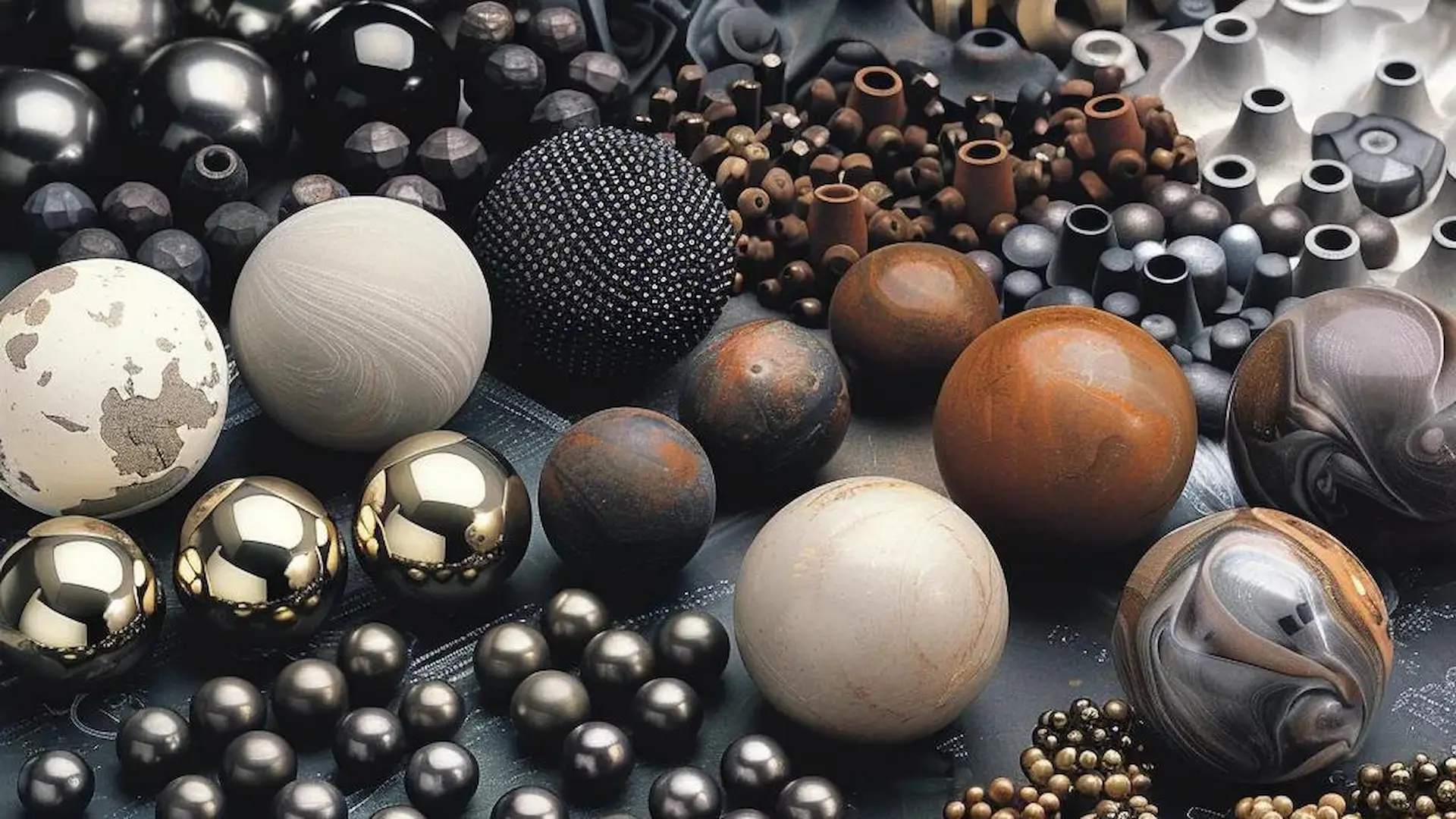
A Technical Guide to Selection, Properties, and Applications
Selecting the appropriate grinding media for a milling process requires balancing material properties, process conditions, contamination limits, and total cost of ownership. This guide provides a technically grounded comparison of common grinding media materials—including steel, ceramics, and specialty options—based on validated mechanical and chemical characteristics.
Key properties reviewed include hardness, density, wear resistance, chemical compatibility, and toughness. Practical selection criteria are presented to help engineers and procurement teams match media performance to milling objectives such as particle-size reduction, energy efficiency, and product purity. Where performance ranges vary by application, conservative, qualified language is used to reflect real-world operating conditions.
Grinding Media in Ball Mills for Mineral Processing (Context Overview)
Grinding media play a central role in ball and stirred mills by directly influencing grinding efficiency, energy consumption, wear rates, and product contamination. Media properties such as hardness, density, fracture toughness, and corrosion resistance determine how energy is transferred to the feed material and how long the media remain serviceable under operating loads.
Proper media selection can improve throughput, reduce energy per ton processed, and lower overall operating costs, particularly in mineral processing, cement, and fine-particle industries.
Key Properties of Grinding Media Materials
Grinding media performance is governed by a combination of mechanical and chemical attributes:
- Hardness – resistance to abrasion and surface wear
- Density – controls impact energy and breakage force
- Wear Resistance – affects media life and contamination levels
- Chemical Compatibility – prevents unwanted reactions or leaching
- Toughness (Impact Resistance) – resists cracking and catastrophic failure
No single material optimizes all properties simultaneously; trade-offs must be evaluated based on application requirements.
How Hardness Affects Grinding Media Performance
Higher hardness generally reduces abrasive wear and helps maintain consistent particle-size distribution over time. However, hardness must be considered alongside toughness, as extremely hard materials may be more brittle.
Representative hardness ranges (by appropriate scale):
- Carbon Steel (case-hardened): Surface hardness up to ~58–62 HRC (case depth dependent; core hardness lower)
- Alumina Ceramic: Mohs ~9; Vickers ~1,500–2,000 HV
- Tungsten Carbide: Mohs ~9–9.5; typically measured in Vickers hardness (~1,700–2,200 HV); not meaningfully measured on the HRC scale
Higher hardness reduces wear debris generation but does not alone determine grinding efficiency.
Why Density Matters in Grinding Media Selection
Density directly influences impact force and energy transfer during milling:
Typical densities:
- Carbon / Alloy Steel: ~7.8 g/cm³
- Zirconia Ceramic: ~6.0 g/cm³
- Alumina Ceramic: ~3.9 g/cm³
- Silicon Nitride: ~3.2 g/cm³
Dense media provide higher impact energy and are generally favored for coarse grinding, while lower-density media are often preferred in fine or stirred milling where controlled attrition is desired.
Wear Resistance, Media Life, and Contamination
Wear resistance determines both media replacement frequency and contamination risk.
General trends:
- High-chrome steel: Good abrasion resistance; moderate corrosion sensitivity in wet environments
- Silicon nitride: Excellent resistance to mechanical and chemical wear
- Glass beads: Low metallic contamination but higher silica wear debris, limiting use in precision applications
Wear behavior is highly application-specific and influenced by feed hardness, mill speed, slurry chemistry, and media size.
Chemical Compatibility and Contamination Control
Chemical compatibility is critical in applications where contamination or ion leaching must be minimized.
- Alumina: Chemically stable in neutral and mildly acidic environments; limited resistance to strong alkalis
- Zirconia: Highly stable across a wide pH range; commonly used in pharmaceutical and food applications
- Steel: May introduce iron-based contamination and corrosion products in aqueous or reactive environments
No grinding media are entirely inert; selection should align with acceptable impurity limits for the finished product.
Toughness and Impact Resistance
Toughness describes a material’s ability to absorb impact energy without fracturing.
Relative behavior (not direct numeric equivalence):
- Steel media: High toughness; resistant to impact-induced breakage
- Silicon nitride: Combines moderate toughness with high hardness
- Tungsten carbide: Extremely hard but relatively brittle; requires controlled operating conditions
Adequate toughness is essential for safe, continuous mill operation.
Comparison of Steel Grinding Media
Carbon, High-Chrome, and Stainless Steel
| Property | Carbon Steel | High-Chrome Steel | Stainless Steel |
|---|---|---|---|
| Typical Hardness | Up to ~60–62 HRC (surface) | ~58–65 HRC | ~55–61 HRC (grade-dependent) |
| Density | ~7.8 g/cm³ | ~7.8 g/cm³ | ~7.8 g/cm³ |
| Corrosion Resistance | Low | Moderate | High (alloy dependent) |
Typical Applications
- Mining and mineral processing
- Cement clinker grinding
- General industrial milling where contamination limits are moderate
Advantages
- High impact energy for coarse grinding
- Economical for large-scale, high-throughput operations
- Robust mechanical durability
Limitations
- Potential iron contamination
- Corrosion in wet or acidic environments
- Less efficient for fine or nano-scale grinding
Ceramic Grinding Media: Advantages and Limitations
Ceramic grinding media are widely used in fine, high-purity applications due to their chemical stability and low metallic contamination.
Comparison of Common Ceramic Media
| Material | Hardness (Mohs) | Density (g/cm³) | Chemical Stability |
|---|---|---|---|
| Alumina | ~9.0 | ~3.9 | Excellent (with limitations in strong alkalis) |
| Zirconia | 8.5–9.0 | ~6.0 | Outstanding |
| Silicon Nitride | ~8.5 | ~3.2 | Very high |
Typical Industries
- Pharmaceuticals
- Food processing
- Electronics and advanced ceramics
- Specialty coatings and pigments
Performance Characteristics
- Lower wear rates than steel in fine grinding
- Significantly reduced metallic contamination
- Stable particle-size distribution over extended campaigns
Ceramic media often provide 2–10× longer service life than steel in fine-grinding applications, depending on operating conditions.
Zirconia vs. Alumina Grinding Media
- Alumina: Cost-effective, suitable for general fine grinding
- Zirconia: Higher density and toughness; lower wear rates under high-stress milling
Zirconia typically carries a 2–3× higher initial cost than alumina but may offer longer service life and lower total cost of ownership in demanding applications.
Specialty and Alternative Grinding Media
Tungsten Carbide
- Density: ~15.6 g/cm³
- Extremely high hardness and wear resistance
- Suitable for ultra-hard materials and precision milling
- Brittle; requires controlled milling conditions
Glass Beads
- Low metallic contamination
- Higher silica wear; limited durability
- Used in low-energy, non-abrasive processes
Plastic Media
- Very low density
- Minimal contamination
- Suitable for polishing or light-duty milling
Selecting the Optimal Grinding Media
Key Selection Factors
- Feed material hardness and abrasiveness
- Target particle size and distribution
- Mill type (tumbling vs. stirred)
- Wet vs. dry operation
- Acceptable contamination levels
Particle Size Guidelines
- Coarse grinding (D97 > 100 µm): Dense steel media
- Intermediate (20–100 µm): High-chrome steel or alumina
- Fine / Nano (< 20 µm): Zirconia, silicon nitride, or tungsten carbide
Cost Considerations
Total cost of ownership includes:
- Media purchase cost
- Wear rate and replacement frequency
- Energy consumption
- Downtime and maintenance
Higher-cost media may reduce long-term operating expenses when wear and contamination are critical.
STR Industries: Precision Grinding Media Solutions
STR Industries applies automotive-grade IATF 16949–compliant quality systems and advanced manufacturing controls to deliver precision grinding media across a wide range of materials.
Quality and Precision
- Controlled grinding and polishing processes
- Laser-based inspection and roundness measurement
- Tight sphericity tolerances (application- and size-dependent)
- Full material traceability
Engineering and Customization Support
- Application-specific media selection
- Diameter, density, and surface optimization
- Support for pilot testing and scale-up
Global Supply Capabilities
- High-volume production capacity
- Direct-to-customer logistics
- Inventory and supply-chain optimization programs
Conclusion
Grinding media selection directly influences milling efficiency, product quality, contamination risk, and operating cost. By aligning material properties with process requirements and purity constraints, manufacturers can achieve consistent performance and optimized total cost of ownership.
STR Industries combines technical expertise, precision manufacturing, and global supply capabilities to support tailored grinding media solutions across industrial, pharmaceutical, and advanced-material applications.
Request for Quote