
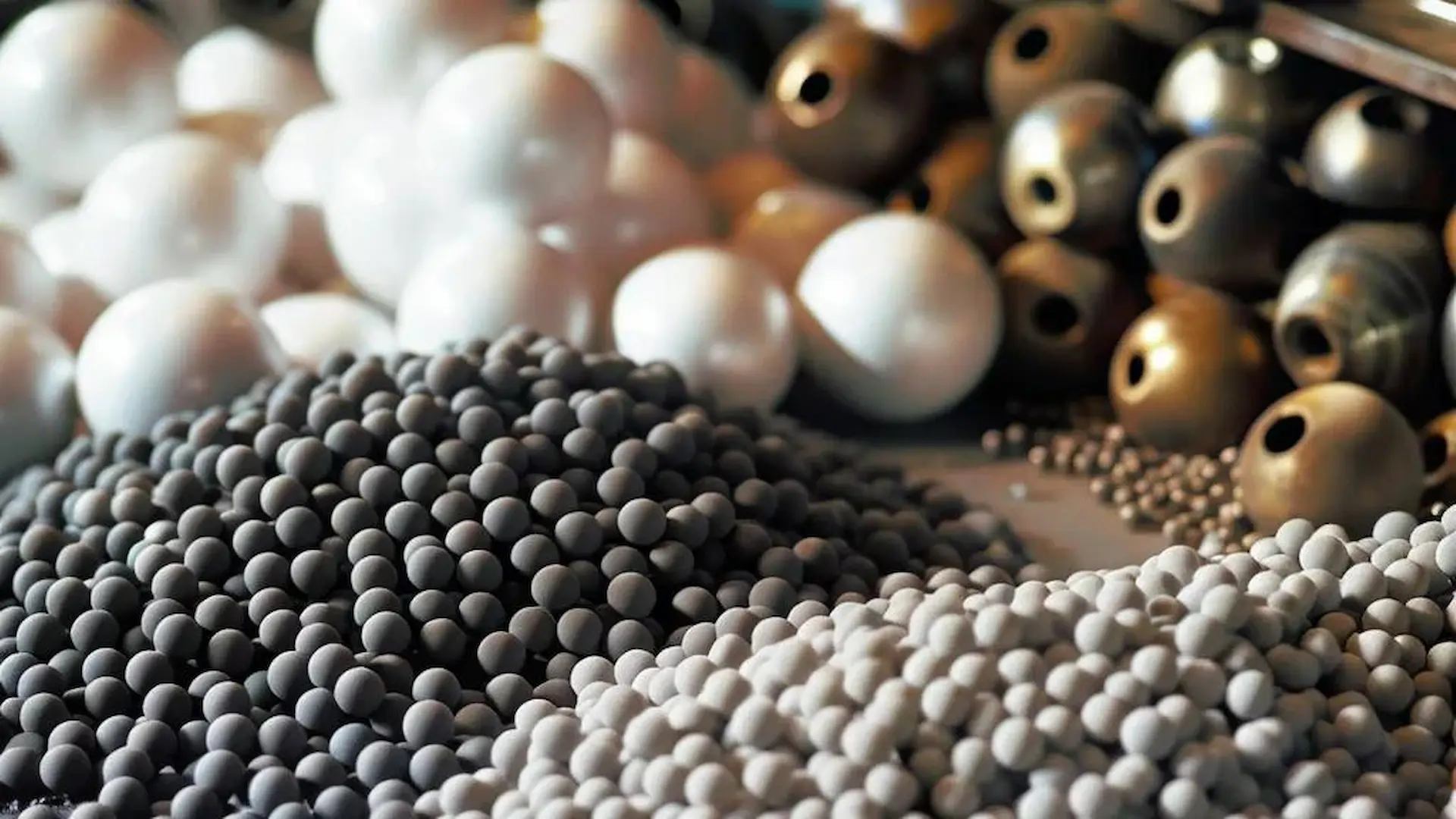
Grinding media are solid bodies—most commonly balls, beads, or rods—used in milling equipment to reduce material size through impact and attrition. Selecting the correct grinding media has a direct effect on milling efficiency, achievable particle size, wear rate, contamination risk, and total cost of ownership.
This guide explains the primary classes of grinding media (steel, ceramic, glass, and plastic), the material properties that govern performance (hardness, density, wear behavior, chemical compatibility, size, and tolerance), and a structured workflow engineers and procurement teams can use to align media selection with application requirements. Industry examples illustrate how different sectors prioritize throughput, purity, and surface finish, while supplier-level considerations translate technical decisions into procurement-ready specifications.
Main Types of Grinding Media and Their Characteristics
Grinding media can be grouped into four principal categories. Each offers a distinct balance of mechanical performance, contamination profile, and cost.
- Steel media (carbon, high-chrome, stainless, forged) provide high density and impact energy, making them suitable for coarse grinding and high-throughput operations.
- Ceramic media (alumina, zirconia, zirconium silicate) combine high hardness with low metallic contamination, supporting fine and contamination-sensitive milling.
- Glass beads offer chemical neutrality and smooth surfaces for dispersion and finishing tasks.
- Plastic media minimize metallic contamination and impact energy, serving low-abrasion or food-grade processes.
Understanding these differences allows engineers to balance throughput, wear life, contamination limits, and operating cost.
Comparative Overview of Media Classes
| Media Type | Typical Mechanical Behavior* | Density (g/cm³) | Purity / Key Notes |
|---|---|---|---|
| Steel (carbon / chrome / stainless) | High hardness and toughness (grade dependent) | ~7.7–8.3 | High impact energy; possible iron contamination |
| Ceramic (alumina, zirconia) | Very hard; zirconia offers higher toughness | ~3.9–6.1 | Low ionic leaching; widely used in pharma/electronics |
| Glass beads | Moderate hardness; brittle | ~2.4–2.6 | Chemically inert; silica wear limits durability |
| Plastic (nylon, UHMW, PEEK) | Low hardness; ductile | ~0.9–1.5 | Minimal metal contamination; low impact energy |
*Hardness and toughness vary significantly by grade and processing method.
Steel Grinding Media: Definition and Key Properties
Steel grinding media include carbon steel, high-chrome steel, stainless steel, and forged steel variants. Each is engineered for specific combinations of hardness, toughness, and corrosion resistance.
- High-chrome steel offers improved abrasion resistance and is commonly used in mining, cement, and coarse mineral milling.
- Carbon steel provides a cost-effective option but typically exhibits higher wear rates and corrosion susceptibility.
- Stainless steel improves corrosion resistance in wet or humid environments and is used where oxidation or rust contamination must be limited.
Hardness correlates with abrasive wear resistance, while toughness governs resistance to fracture under impact. Because these properties vary by alloy and heat treatment, engineers must match steel grade to mill dynamics, slurry chemistry, and contamination tolerance.
Typical supplier specifications include hardness ranges (Rockwell C), diameter and sphericity tolerances, surface finish, and size availability to support mill loading and energy-transfer calculations.
Ceramic Grinding Media: Purity and Performance Differences
Ceramic grinding media primarily include alumina (Al₂O₃), zirconia (ZrO₂), and zirconium silicate. These materials differ in hardness, fracture toughness, density, and leachable-ion behavior—factors critical in contamination-sensitive processes.
- Alumina provides high hardness and good wear resistance at relatively moderate cost.
- Zirconia offers higher density and transformation toughening, resulting in lower wear rates under high-stress milling.
- Zirconium silicate occupies a middle ground in cost and performance for selected applications.
Purity level (e.g., 92%, 95%, 99.5% alumina) and microstructure strongly influence wear behavior and trace-ion release. Higher-purity ceramics generally exhibit more predictable abrasion and reduced contamination risk, which is why they are favored in pharmaceuticals, electronics, and advanced materials.
Trade-offs include higher unit cost, potential brittleness under extreme impact, and the need for careful mill-speed control.
Glass and Plastic Grinding Media: Uses and Benefits
Glass beads and engineered plastic media serve specialized roles where chemical neutrality, surface finish, or contamination control outweigh the need for aggressive size reduction.
- Glass beads are chemically inert and provide smooth finishes, making them suitable for polishing, pigment dispersion, and surface conditioning. However, silica wear limits their service life in abrasive systems.
- Plastic media (nylon, UHMW, specialty polymers) minimize metallic contamination and reduce impact energy. They are commonly used in food-grade, cosmetic, or gentle mixing applications.
Both media types have lower density than steel or ceramics, resulting in reduced impact energy and throughput. They are best suited for finishing, dispersion, or low-abrasion processes.
Properties That Influence Grinding Media Performance
Grinding media selection depends on multiple interrelated properties that govern milling kinetics, contamination risk, and lifecycle cost.
| Property | Measurement Method | Impact on Milling |
|---|---|---|
| Hardness | Rockwell (HRC/HRA), Vickers | Influences wear rate and service life |
| Density | g/cm³ | Determines impact energy per collision |
| Diameter tolerance | Micron-level measurement | Controls energy consistency and PSD |
| Chemical compatibility | Leach testing, ICP analysis | Limits contamination risk |
| Wear rate | % mass loss per ton | Drives cost per ton milled |
Tighter tolerances improve repeatability, while appropriate density and hardness ensure efficient energy transfer without excessive wear or fracture.
Hardness, Wear Resistance, and Grinding Efficiency
Higher hardness generally reduces abrasive wear and extends media life, lowering replacement frequency and operating cost. However, extreme hardness can increase brittleness, raising the risk of chipping or fracture under high-impact conditions.
Wear behavior also affects contamination: higher wear rates introduce more debris into the product, potentially requiring downstream filtration or purification. Engineers should evaluate hardness alongside fracture toughness and wear-test data to select media that minimize lifecycle cost without introducing failure risk.
Density and Impact Energy Considerations
Density directly affects impact energy during milling. At a given mill speed, heavier media deliver higher kinetic energy, accelerating particle breakage and improving throughput for coarse and intermediate grinding.
Lower-density media reduce impact energy and are better suited for polishing, dispersion, or contamination-sensitive tasks where aggressive breakage is undesirable. Selecting density therefore involves matching energy input to target particle size while managing liner wear and media degradation.
Chemical Inertness and Contamination Control
Chemical compatibility is critical where trace ions or particulate contamination can affect product performance or regulatory compliance.
High-purity ceramics and glass exhibit low ionic leaching and are widely used in pharmaceuticals, medical devices, food, and fine chemicals. Stainless steel may be acceptable where small metal traces are tolerable, particularly with passivation and proper process control.
Contamination control typically includes pre-cleaning media, controlled operating conditions, post-mill filtration, and analytical validation (e.g., ICP-MS). Supplier-provided purity data and representative sample testing are essential for qualification.
Selecting the Right Grinding Media: A Structured Workflow
Effective selection follows a stepwise process:
- Define contamination limits and target particle-size distribution
- Match required impact energy to media density and size
- Select material based on chemical compatibility and wear behavior
- Conduct pilot or sample-scale milling to validate performance
- Specify diameter tolerance, sphericity, and surface finish
- Evaluate total cost of ownership rather than unit price alone
This approach converts technical priorities into procurement-ready requirements.
Industry-Specific Media Recommendations
| Industry / Application | Primary Concern | Recommended Media |
|---|---|---|
| Automotive finishing | Throughput, durability | High-chrome or forged steel |
| Pharmaceutical / Medical | Contamination, traceability | Zirconia or high-purity alumina |
| Inks & pigments | Color stability, dispersion | Glass beads or ceramics |
| Food processing | Non-toxic, low metal | Plastic or glass |
| Aerospace | Surface integrity, fatigue | Forged steel or tough ceramics |
Supplier Considerations and STR Industries Capabilities
A qualified supplier should provide documented specifications, testing support, and scalable production.
STR Industries supports grinding media selection through engineering consultation and custom manufacturing across steel, ceramic, and plastic materials. Capabilities include:
- Sizes from approximately 0.8 mm to 80 mm
- Custom diameter production with tight tolerance control (application-dependent)
- Published material properties (hardness, density, wear data)
- IATF 16949–compliant quality systems
- High-volume production capacity and global supply
These capabilities support both regulated industries and high-throughput manufacturing environments.
Frequently Asked Questions
What are the most common grinding media types? Steel, alumina ceramic, zirconia ceramic, glass beads, and engineered plastic media.
How do you minimize contamination? Select chemically compatible materials, specify tight tolerances, pre-clean media, validate via sample milling and analytical testing, and work with traceable suppliers.
What is the impact of low-density media? Lower impact energy reduces throughput but improves contamination control and surface finish in gentle or finishing applications.
Conclusion
Grinding media selection is a balance of mechanical performance, chemical compatibility, contamination risk, and cost. No single media type is optimal for all applications; performance depends on matching material properties to mill design, process chemistry, and product requirements.
By combining structured selection criteria with supplier validation and testing, engineers and procurement teams can specify grinding media that deliver consistent performance, controlled contamination, and optimized total cost of ownership.
Request for Quote