

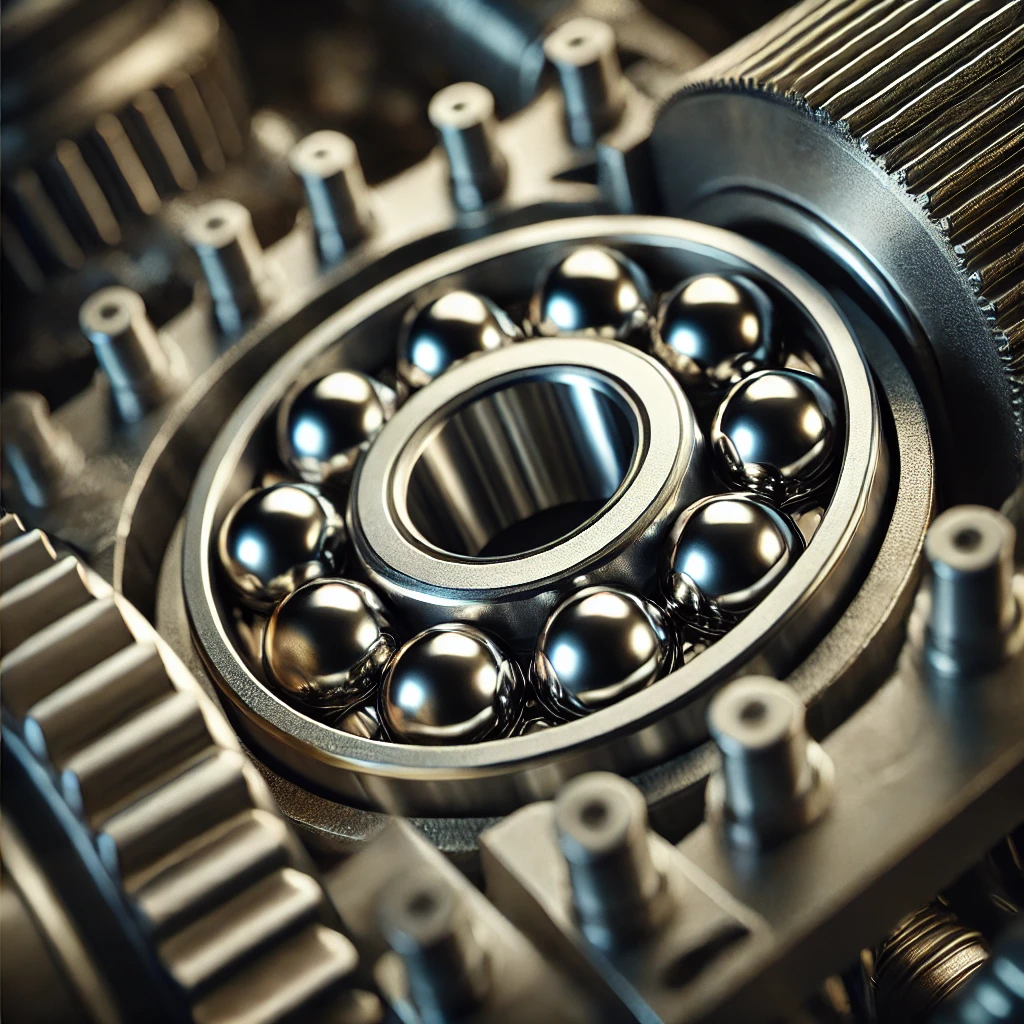
Every precision machine that moves in a straight line depends on the same humble component: the steel ball. Linear sliders, the assemblies that guide machine axes, carriages, and tooling along a straight path, use recirculating steel balls to replace sliding friction with rolling friction. The result is motion with friction coefficients as low as 0.002 to 0.01, smooth travel at speed, and service lives measured in thousands of kilometers.
How Recirculating Ball Sliders Work
A linear slider has two main parts: a rail or shaft, and a carriage that rides along it. Between them sit rows of steel balls that roll in hardened raceways, carrying the load while the carriage moves. At each end of the carriage, the loaded raceway ends in a deflection channel that steers the balls into an unloaded return channel inside the carriage body. The balls pass through the body and re-enter the loaded raceway at the other end, forming a closed recirculation loop.
That loop is the key idea. Because the balls recirculate, travel length is limited only by the rail itself, and fresh balls are always entering the load zone. Modern carriages add ball cages or separators that keep the balls from rubbing against each other, which cuts friction, noise, and heat while holding lubricant where it belongs.
Two Slider Designs: Ball Bushings and Profile Rail Guides
Linear ball systems come in two families, and the balls work differently in each:
- Ball bushings (round shaft): the carriage rides on a round shaft, with each ball making single point contact. They are smooth, forgiving of misalignment, lower cost, and lower maintenance. Load capacity is modest, which suits 3D printers, packaging machinery, medical sample handling, and light factory automation.
- Profile rail guides: the carriage rides on a shaped rail, with each ball contacting the raceway at two or four points in a Gothic arch or circular arc groove. This geometry makes profile rail assemblies roughly five times stiffer under load than round-shaft designs, and the carriages can be preloaded for high rigidity and micrometer-level accuracy. They cost more and demand better mounting surfaces, which is why they dominate CNC machine tools, semiconductor equipment, and precision assembly machines.
Both designs depend on the same thing: balls manufactured to tight tolerances with hard, smooth surfaces. That is where ball quality directly becomes machine performance.
Chrome Steel vs Stainless Steel Balls
The standard ball material in linear systems is AISI 52100 chrome steel, through-hardened to about 58 to 66 HRC. It earned that position through high hardness, wear resistance, and excellent rolling-contact fatigue life in lubricated service. Rails, carriages, and rolling elements in most linear guides are made from this bearing steel.
Chrome steel has one limitation: it is not corrosion resistant. The 1.3 to 1.6 percent chromium in 52100 is far below stainless levels, so unprotected balls will rust. For corrosive environments, 440C stainless steel balls are the answer. This martensitic stainless hardens to about 58 to 60 HRC and resists corrosion far better than chrome steel, which makes it the choice for food processing machinery, medical equipment, cleanrooms, washdown applications, and semiconductor tools. The tradeoff is a small reduction in load capacity compared with 52100, and higher cost.
STR Industries manufactures both chrome steel and stainless steel precision balls, so the ball material can be matched to the operating environment rather than compromised.
Why Ball Precision Decides Slider Performance
Precision balls are graded under the ISO 3290 and DIN 5401 systems, where the grade number reflects the diameter tolerance per ball. A G10 ball holds diameter tolerance to 0.25 microns with matching sphericity and a surface roughness of just 0.025 microns Ra. Tighter grades mean rounder, smoother, more uniform balls.
In a linear slider, that precision translates directly into performance:
- Smooth motion: uniform balls roll without the vibration and stick-slip that oversized or out-of-round balls introduce.
- Even load distribution: balls of consistent diameter share the load equally instead of overloading a few high balls, which extends fatigue life.
- Positioning accuracy: in precision guides, ball variation shows up as straightness and repeatability error in the machine axis.
Lubrication Keeps the System Alive
Rolling contact still needs lubrication. Grease, typically NLGI grade 1 or 2, is used in the large majority of linear bearing arrangements: it stays in place, seals against contaminants, and needs attention only at intervals measured in months or hundreds of kilometers of travel, depending on the manufacturer and duty. Oil lubrication suits high-speed or high-heat applications where heat must be carried away. Either way, running a recirculating ball slider dry shortens its life dramatically, since catalog load ratings assume proper lubrication.
Where Steel-Ball Sliders Work
Ball-based linear motion systems are standard equipment across industry:
- CNC machine tools: milling, grinding, and turning centers ride on profile rail guides for rigid, accurate axis motion.
- Semiconductor and electronics manufacturing: wafer handling, LCD processing, and circuit-board assembly demand clean, precise linear motion, often with stainless components.
- Factory automation and robotics: pick-and-place units, positioning stages, and gantry axes.
- Packaging and material handling: high-cycle machinery where smooth, low-maintenance linear motion keeps lines running. Ball transfer units, which use free-rolling balls in a housing, handle the related job of moving loads across conveyor and transfer surfaces in any direction.
- Medical and laboratory equipment: diagnostic instruments and sample handling where smooth, contamination-free motion matters.
- 3D printers and light machinery: ball bushings on round shafts deliver smooth motion at low cost.
The Right Balls for Your Linear System
A linear slider is only as good as its balls. Grade, material, and surface finish determine friction, life, noise, and accuracy, and getting them right at the design stage prevents expensive retrofits later.
STR Industries manufactures precision steel balls in the United States under ISO 9001 and TS 16949 certified quality systems, in sizes from 1/64 inch to 6 inches. Whether your application needs chrome steel for a machine tool axis or stainless for a washdown environment, we supply balls made to the specification your system demands. Request a quote or contact our team to discuss your linear motion application.
Related reading: What Are Ball Transfer Units? Uses, Types & How to Choose the Right One · Ball Transfer Units vs. Traditional Bearings: Which Is Right for Your Application?