
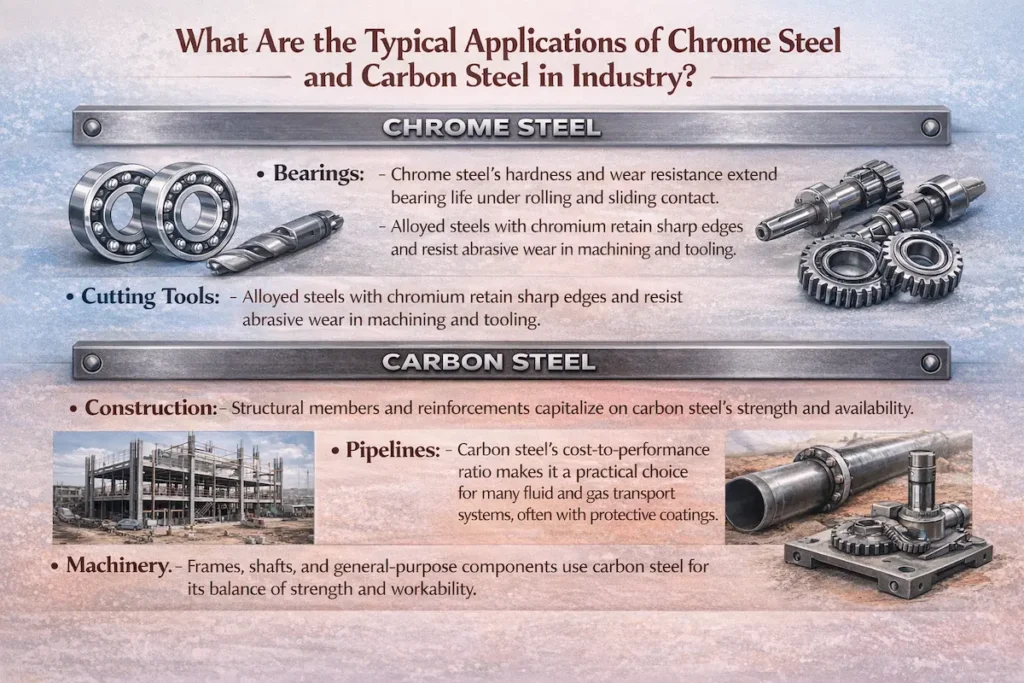
Chrome steel and carbon steel balls look identical in a parts bin, but they are built differently and they fail differently. Specify the wrong one and you either pay for precision you will never use, or you replace parts long before you should. This guide compares the two materials as they are actually supplied for balls, so you can pick the right one for your bearing, valve, slide or conveyor before you request a quote.
The short answer
Choose chrome steel when the ball carries real load, runs at speed or must hold a tight tolerance: precision bearings, ball screws, valves and instruments. Choose carbon steel when the ball does lighter, slower work and cost per piece matters most: drawer slides, casters, conveyors, ball transfer units and general assemblies. If the part will see water, washdown or chemicals, neither is the right answer on its own; see the corrosion note below.
| Factor | Chrome steel balls | Carbon steel balls |
|---|---|---|
| Typical material | AISI 52100 (about 1% carbon, 1.3–1.6% chromium) | Low-carbon AISI 1010 / 1015, case-hardened |
| How it is hardened | Through-hardened: hard all the way to the core | Case-hardened: hard outer shell over a softer core |
| Surface hardness | About 60–66 HRC | About 60 HRC at the surface; the core is much softer |
| Precision grades | Available in very tight grades (down to G3–G5) | Usually commercial grades (G100 and looser) |
| Load and speed | High loads, high speeds, long running hours | Light to moderate loads, lower speeds |
| Corrosion resistance | Low: will rust if left dry and exposed | Low: will rust; often plated or oiled |
| Relative cost | Higher | Lower |
What chrome steel balls are
Almost every chrome steel ball is made from AISI 52100 (also sold as 100Cr6 or SUJ2). It is a high-carbon bearing steel with a small chromium addition. The chromium is there to help the steel harden deeply and evenly; it is not enough to make the ball stainless. After heat treatment the ball is hard from surface to core, which is why it holds its shape under heavy rolling loads and can be ground and lapped to very fine size and roundness tolerances.
That precision is what you pay for. Chrome steel is the standard material for precision bearing grades and for steel balls covered by ISO 3290. See our chrome steel balls for available sizes.
What carbon steel balls are
Carbon steel balls are usually made from low-carbon steel and then case-hardened: carbon is diffused into the surface during heat treatment, leaving a hard, wear-resistant skin over a tougher, softer core. The result is a ball that rolls well and resists surface wear in everyday use at a noticeably lower price than chrome steel.
The trade-off is depth. Once the hardened case is worn through or crushed, the soft core underneath wears quickly. Carbon steel balls are also normally supplied in looser commercial grades, which is fine where a few ten-thousandths of an inch do not matter. See our carbon steel balls for options.
Where chrome steel balls are the right call
- Precision and high-speed bearings, including electric motors, spindles and automotive wheel bearings.
- Ball screws and linear guides where positioning accuracy depends on ball size consistency.
- Valves and check valves where the ball must seal against a seat and keep its roundness.
- Instruments, gauges and medical devices that need tight grade and tolerance control.
- Any application with heavy or continuous load, where a case-hardened ball would wear through.
Where carbon steel balls make more sense
- Drawer slides, furniture and appliance hardware with light, intermittent loads.
- Casters, conveyors and ball transfer units moving packages or light goods.
- Bicycle, toy and sporting goods assemblies where cost per unit drives the decision.
- Non-critical bearings and detents where commercial-grade tolerances are acceptable.
- High-volume programs where the price difference across millions of balls is significant.
A note on corrosion: neither one is stainless
It is a common misconception that chrome steel resists rust. At 1.3–1.6% chromium, 52100 does not form the protective film that stainless steel relies on (that needs roughly 10.5% chromium or more). Both chrome and carbon steel balls will rust if they are stored dry or run in wet conditions. They are normally shipped oiled, and carbon steel balls are often plated for extra protection.
If your application sees water, steam, washdown, food contact or chemicals, look at stainless steel or ceramic balls instead.
Questions to answer before you request a quote
Having these details ready gets you an accurate recommendation and price faster:
- Size: nominal diameter (inch or metric) and quantity.
- Grade: the tolerance your design actually requires, not the tightest one available.
- Load and speed: roughly how much weight each ball carries and how fast it runs.
- Environment: dry, oily, wet, hot or chemical exposure.
- Finish and packaging: oiled, dry or plated; bulk or packaged.
- Documentation: any material certification or inspection report you need.
Not sure which material fits? Our ball selection guide walks through the options, and for how each material holds up over time see chrome steel vs carbon steel durability.
Frequently Asked Questions
Are chrome steel balls better than carbon steel balls?
They are stronger, more precise and longer-lasting under load, but they cost more. For light-duty, cost-sensitive applications, carbon steel balls perform well and are the better value.
Is chrome steel rust-proof?
No. Standard chrome steel (AISI 52100) contains only about 1.5% chromium and will rust without oil or other protection. For corrosion resistance, specify stainless steel or ceramic balls.
What does case-hardened mean for a carbon steel ball?
Only the outer layer is hardened; the core stays softer. This gives good surface wear resistance at low cost, but the ball wears quickly once that outer layer is gone.
Can carbon steel balls be used in bearings?
Yes, in light-duty and low-speed bearings such as those in drawer slides, casters and conveyors. High-load or high-speed bearings should use chrome steel.
Which steel ball grade do I need?
Choose the loosest grade that meets your design tolerance. Precision bearings and instruments typically need tight chrome steel grades; most general hardware works with commercial grades. Ask us if you are unsure.
Ready to compare options for your part? Request a quote with your size, grade and quantity, and we will recommend the right material.
Related reading: Stainless Steel Balls: Characteristics and Industry Applications · Chrome Steel vs Stainless Steel — Clear Differences and Which to Choose