
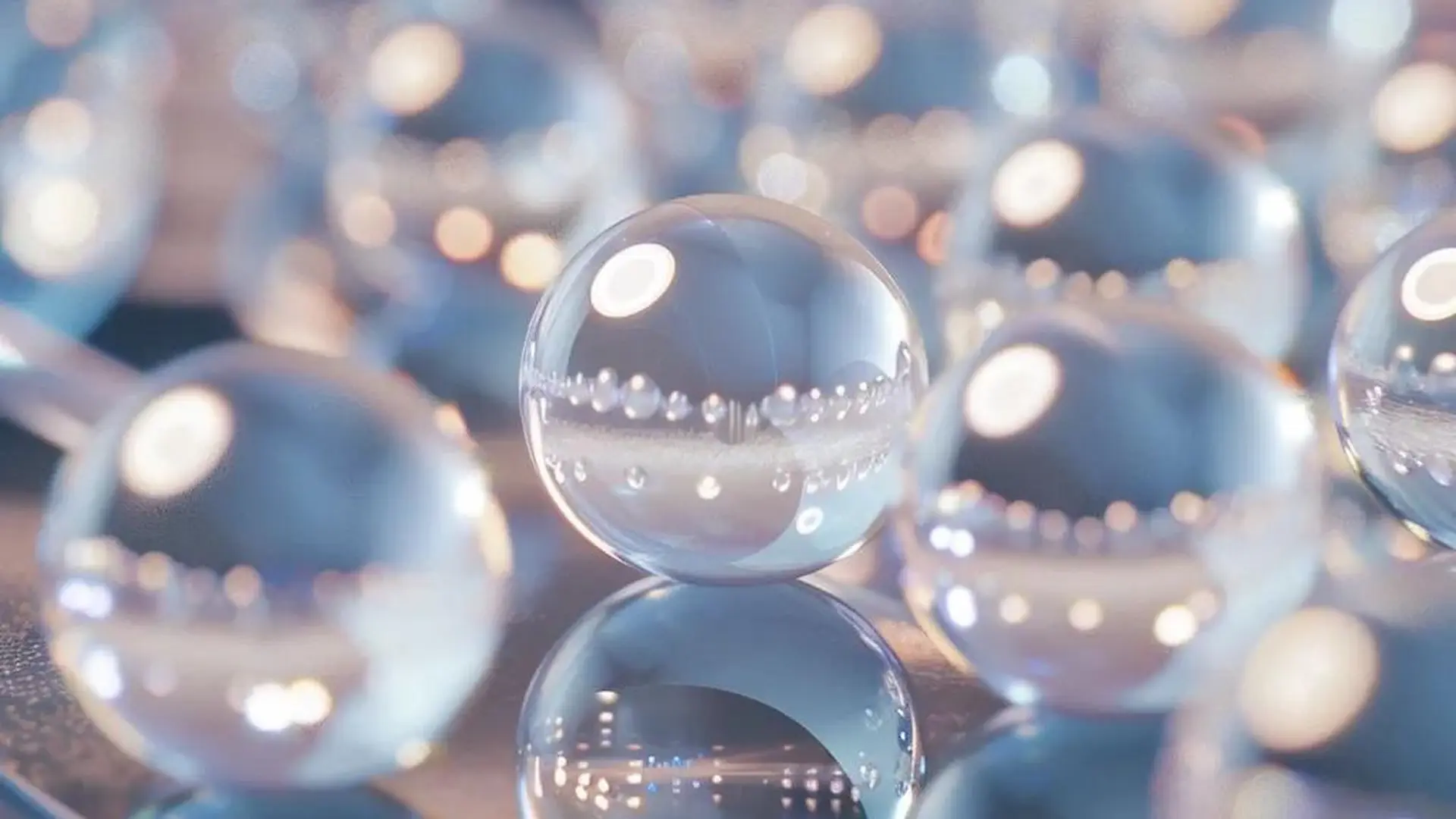
Soda-lime glass balls are the workhorse of the precision glass ball world. They combine chemical inertness, a smooth hard surface, and an economical price point, which is why they show up in everything from check valves and metering pumps to ink cartridges and fiber optic devices. STR Industries manufactures soda-lime glass balls to tight tolerances for industrial applications where reliability and consistent performance matter.
What Soda-Lime Glass Is
Soda-lime glass is the most common glass formulation in the world. It is made primarily from silica (about 70 to 74 percent by weight), soda or sodium oxide (about 13 to 15 percent), and lime or calcium oxide (about 9 to 10 percent), with small amounts of alumina and other oxides. The soda lowers the melting temperature so the glass can be worked economically, and the lime gives the finished glass its chemical durability and hardness.
Key Properties
The properties below are standard published values for soda-lime glass, and they explain why the material suits so many ball applications:
- Density: about 2.5 g/cm3, roughly one third the density of steel. Lightweight balls reduce inertia in moving assemblies and cut shipping weight.
- Hardness: about Mohs 6. Hard enough to resist scratching and wear in valve seats and metering applications, yet softer than the metals it runs against, so it will not gall or score mating surfaces.
- Chemical resistance: good resistance to water, most acids, and organic solvents, rated hydrolytic Class 3 under ISO 719. The balls do not corrode, rust, or shed metal ions into the product stream.
- Refractive index: about 1.51 to 1.52, which gives the clear, bright finish used in optical and decorative applications.
- Thermal behavior: coefficient of thermal expansion around 9 x 10⁻⁶/K with a softening point near 720 C, adequate for ambient and moderately elevated temperature service.
- Electrical insulation: glass is a natural electrical insulator, useful in electronic and instrument applications.
How Precision Glass Balls Are Made
Precision glass balls start as molten glass. In the standard production route, molten glass is dripped or cut into gobs from a feed nozzle, and each gob rounds into a sphere under surface tension as it cools. A second industrial route passes a molten glass stream between counter-rotating rollers with hemispherical cavities that form the beads directly.
The as-formed ball is close to round but not precise. Reaching ball-grade tolerances requires cold finishing: the balls are ground and polished to final diameter, sphericity, and surface finish. That finishing step is what separates a decorative glass marble from a precision ball that will seal reliably in a check valve or meter accurately in a pump.
Specifications and Tolerance Grades
Precision balls are graded under the AFBMA/ABMA system, where the grade number reflects the diameter tolerance per ball in millionths of an inch. Grade 25 is a common standard for precision glass spheres, with tighter grades available for optical and instrument work and looser grades for decorative use.
Typical application tolerances for soda-lime glass balls:
- Optical and precision instruments: sphericity to plus or minus 0.005 mm
- Valves and fluid handling: sphericity to plus or minus 0.025 mm
- Decorative and general use: sphericity to plus or minus 0.10 mm
STR Industries supplies soda-lime glass balls in sizes from 1/64 inch to 6 inches in virtually any increment, ground and inspected to the tolerance your application requires.
Industries and Applications
Soda-lime glass balls are valued for their versatility. Typical uses include:
- Check valves and low-cost control valves: the ball seats tightly, resists the fluid being handled, and will not corrode in service.
- Metering pumps and flow meters: consistent diameter and smooth surface give repeatable metering and measurement.
- Measuring instruments and agitators: chemically inert balls that do not contaminate sensitive processes.
- Plastic and special bearings: lightweight, non-magnetic rolling elements for corrosion-sensitive bearing designs.
- Fiber optic devices: precise, defect-free spheres for coupling and alignment components.
- Ink cartridges and bottle closures: smooth, uniform balls that seal reliably at low cost.
- Shot blasting and grinding: glass media produces fine, clean surface finishes without introducing metal contamination.
- Art and decoration: clear finish and adaptable form for decorative projects.
Why Buy Soda-Lime Glass Balls From STR Industries
STR Industries is a US manufacturer with more than 50 years of ball manufacturing experience, operating under ISO 9001 and TS 16949 certified quality systems. We manufacture glass grinding media in-house, which means your soda-lime glass balls come from the people who made them, not from a trading chain. Every lot is produced to specification and inspected before it ships, so the balls that arrive match the balls you qualified.
Because we manufacture domestically, you get stable pricing unaffected by tariff shifts, short lead times, and direct engineering support when you need help selecting a grade, size, or tolerance.